Scores, sound and video, selected and presented by the composer, sound artist and events organiser Charlie Morrow (US/Finland, 1942) and curated by Charlie Morrow, Livia Schweizer, Oliver George-Brown and Isaac Otto.
Yes and NoTation brings together scores representing over a century of musical experimentation, centering the ways in which music’s inscription can play a vital role in the act of reading and interpretation. These diverse scores complicate our binary understanding of improvisation-versus- reproduction, using symbol, image, text, color, and process to tweak traditional forms of notation, impose creative constraints, call upon players’ visual imaginations, or otherwise play in new and challenging ways—resulting in sounds often inaccessible to more traditional forms of inscription.
The exhibition also serves to celebrate three years of iMMERSE!, an experimental podcast and unique, immersive aesthetic experience, comprising interviews with an inter-generational cast of avant-garde artists, composers, performers, and sound poets in vibrant discussions of their work and creative practice.
The pop-up exhibition at Kohta happened in connection with the outdoor event SoundCircus (Teurastamo, Helsinki, 23–27 July 2025).
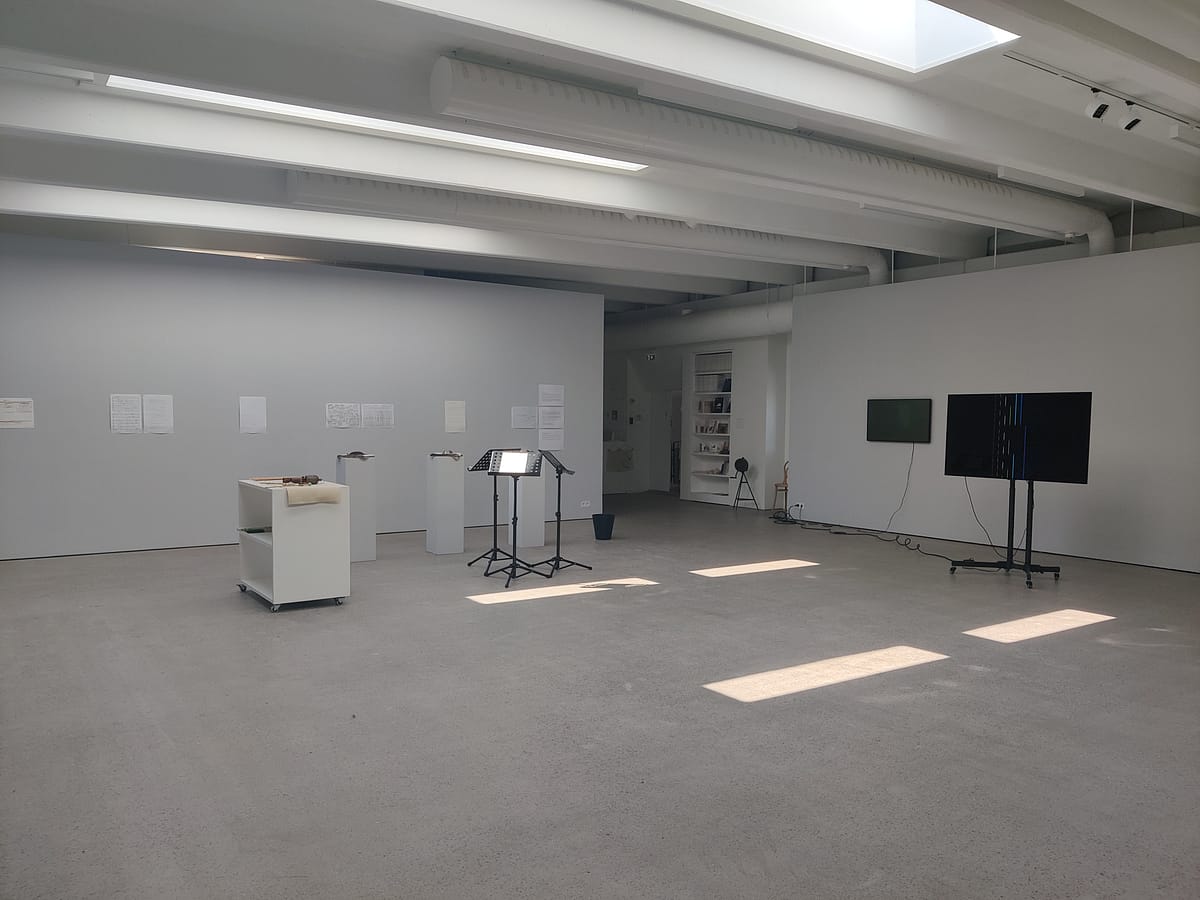
Exhibition view from Yes and NoTations
The works in the exhibition:
Excerpt from Arseny Mikhailovich Avraamov’s Symphony of Sirens, 1923, with fabric flags
On 7 November 1922 in Baku, Azerbaijan, Avraamov conducted his large-scale Symphony of Sirens from a rooftop, in celebration of the five-year anniversary of the October Revolution. The performance included sirens, whistles, horns and bells from buses, cars, and the entire Soviet flotilla in the Caspian Sea; cannon; a large band and choir; and Avraamov’s own magistral, an instrument with 50 independently-controlled pipe whistles.
William David Fastenow, Wave Music XII: 1001 Charlies, 2023. For Charlie Morrow with conch shell and electronics. Digital video (still images)
A continuation of Morrow’s Wave Music series for herds of instruments, Wave Music XII multiplies Morrow’s live conch shell performance in space and time. This matrix charts the 1000 locations of the moving sound in space.
Oliver George-Brown, Dispense Me Some Score, 2025. For any number of performers with variable instrumentation Ink on paper towel and hand towel dispensers
This experimental score project involves colorful notation inscribed improvisationally by hand onto 200m long rolls of paper, which are then loaded into two automatic hand-towel dispensers. Performers must continually dispense and discard stretches of score, which requires negotiating the functional constraints of these ubiquitous everyday technologies. Gallery visitors are welcome to dispense themselves a piece of score to take home, if desired!
Oliver George-Brown, Chop, Chop!, 2024. For two performers, four channels, various utensils, and assorted vegetables. Felt-tip pen and alcohol marker on bristol board, 36 × 28 cm
In this stylised ritualisation of the everyday process of food preparation, performers retrieve, prepare, and deposit a series of salad ingredients. The repetitive sounds of peeling, chopping, and slicing establish moments of polyrhythmic juxtaposition against the shifting periodicity of the multichannel tape track.
C.M. von Hausswolff, Lament (for Hans Gustaf, Adelaide and Carl Ulrik) for Treated Locations Recordings, Sinewave Fragments, Lute, and Electronic Voice Phenomena, 2025. Acrylic marker with mixed-media posters
Painted directly onto the wall by the artist, this rendering of Lament expands on the piece’s base material. Von Hausswolff’s multifaceted practice explores concepts of the unknown, of “humanimal” relations, and of the relationship between abstract electronic sound and mechanically captured sound.
Miika Hyytiäinen, NOS Ship, 2018
“NOS is a piece about surveillance through the voice. The audience was walking through picturesque alpine scenery and this scene was sung on a ship that is also the shape of the score. The text of this section is ‘the measures of the ship shape reality irrevocably.’”
Juhani Liimatainen, Charlie Morrow, Jan Noponen, Juhani Nuorvala, SOS, 2025
Annea Lockwood, Humming, 1972. Ink on paper, 29.7 × 42 cm. Re-engraved 2025 by Livia Schweizer
“Humming, by vibrating so much of the skull, can transform your state, increasing your physical energy, pulling you towards ecstasy. When done by a number of people the sound mass takes on an almost disembodied quality, floating in the room detached from the hummers.”
Annea Lockwood, bayou-borne, for Pauline, 2016. For six players, vocal and/or instrumental
An homage to celebrated composer and accordionist Pauline Oliveros, bayou-borne “acknowledges [Pauline’s] birthplace, Houston, her sensitivity to the nonhuman environment, her great contribution to the art of listening to the environment and to one another, and her brilliance as an improviser.”
Karen Mac Cormack, Quaquaversal, 2019
This excerpt from Mac Cormack’s poem “TAI PING ENCORE” from the recently published QUAQUAVERSAL (VEER Books, London, 2024) represents “a deliberate estranging of the English language with an accompanying glossary of the ‘meanings’ of the new words created from the original scriptio continua.”
Steve McCaffrey, Carnival, 1967–2020. Digital video (still images)
A landmark work of concrete and visual poetry, Carnival is composed of four panels, each representing a distinct phase in McCaffrey’s radical exploration of language, materiality and the visual dimension of text. Described by McCaffrey as a ”multi-panel language environment,” Carnival was first constructed primarily with a typewriter, later incorporating other technologies and methods.
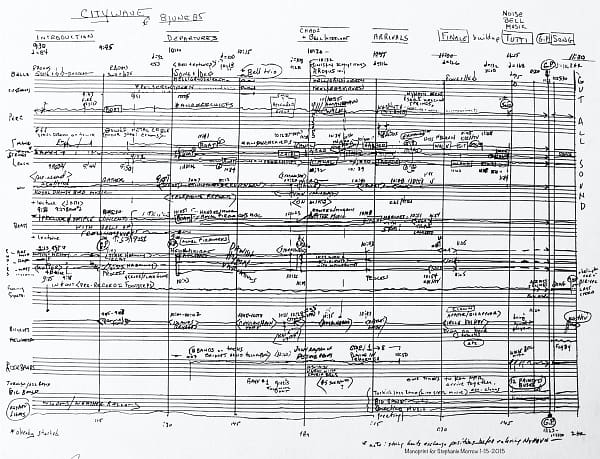
Charlie Morrow, City Wave, 1985/1989. Silkscreen on cloth, 132 × 160 × 2.4 cm. Edition Conz, Verona, Italy, author’s copy, on loan from ML Remes
Morrow’s largest public event City Wave (for all of Copenhagen), commissioned by Copenhagen International Theatre for Fools Festival, invited participation by the entire city— more than 1000 performers, the city’s many church bells, rock bands, clowns, fire dancers, percussionists on barges, military bands, a helicopter. Morrow’s hand-drawn score shows the entrances and exits of the musicians and vehicles over the event’s two-hour duration.
Charlie Morrow, Kaddish in Tibetan Style, 1974. For unaccompanied voice with bells Ink and acrylic on paper
Performed on many occasions since its composition, Morrow’s Kaddish is an interpretation of a traditional Jewish mourner’s prayer in Aramaic. Morrow typically performs the piece solo, chanting one syllable per breath and playing a handheld gong.
Charlie Morrow, Excerpts from the iMMERSE! podcast series, 2022–25 Digital video with audio, six excerpts, 14′
The iMMERSE! podcast series explores the concept of immersivity as it relates to multidisciplinary creative practices. Amongst others, these excerpts feature conversations with composers Annea Lockwood and Rip Hayman, as well as archaeologist and anthropologist William Fitzhugh.
Charlie Morrow, Arctic Spring, 2025, Remixed Yle Radio Suomi archival recordings, 15′
In 1979, Morrow visited Finland for the first time to participate in a creative exchange with Juhani Liimatainen at the Experimental Studio of Yle Radio Suomi. Morrow performed a live broadcast with conch shell, rattles, and other small instruments, and in return was granted access to the station’s archives. He was particularly interested in gathering historical recordings of arctic sounds, which he then composed into long-form radio works for the public broadcasters Westdeutscher Rundfunk (Germany) and Österreichischer Rundfunk (Austria).
Isaac Otto, Nemat-space, 2023, rev. 2025. For two multi-instrumentalists with tape recorders and little instruments.
Written for a multi-instrumental duo, Nemat-space (an homage to surreal theorist Reza Negarestani) has players begin at top left and navigate to bottom right in their own time, performing gestures described by each cell. Each cell provides a specific instruction which applies to their primary instrument, to their tape recorder, or to their little instruments.
Isaac Otto, LUCA, 2025. For two instrumentalists.
Composed for performance at SoundCircus, LUCA consists of a grid of 219 “life stages” of a hypothetical bicellular organism (our Last Universal Common Ancestor). Beginning with a single cell, we see early life move, divide, coalesce, occupy, digest, mutate, swell, shrink, emerge, reproduce, die. Performers situated at either end of the score weave through the work contrariwise, developing individual strategies by which to decode and sound these cell-bodies and their inscrutable actions.
Isaac Otto, Improvisation (999 Transiences), 2025. For any number of musicians. 999 laser-printed scores on newsprint, music stands, collected instruments and wastebasket
An interactive installation, Improvisation comprises 999 disposable one-page melodies along with a variety of music-making accessories. Performers (those selected in advance as well as self-chosen members of the audience) may, at any point during the installation period, perform a melody in the designated space using an instrument or their choosing or one provided. Following performance, its score is destroyed. The piece concludes when all 999 Transiences have been performed and destroyed, a process which will likely take several years. All musicians in the gallery are invited to take part in the work by selecting a melody from one of the three plinths, interpreting it using their own instrument or instruments provided, then disposing of it in the nearby wastebasket.
Bart Plantenga, Posters for the iMMERSE! podcast series, 2022–25
Each poster represents a different iteration of Charlie Morrow and Bart Plantenga’s iMMERSE! podcast series, in which a diverse range of arts practitioners discuss their relationship to the concept of immersivity. A compilation of excerpts from selected interviews can be viewed on the opposite wall of this room.
Ville Pulkki, Fractal Music, compiled 2025. Digital video and audio, 6′
Pulkki, a professor of acoustics at the Aalto University in Espoo, develops work which often unites music and mathematical concepts. Fractal Music sonifies the “Koch snowflake,” one of the simplest fractal forms—an infinite recursion of triangular forms.
Livia Schweizer, Rose Garden—“Your Lovely Eyes”, 2024. For at least two players. Ink on paper
An excerpt from a series of scores commissioned by the Organic Sound Society of Helsinki for an exhibition at the Oulu Art Museum, Rose Garden serves as an invitation to let sounds flow, resonate, and encounter those of other performers, challenging players to experience an intimate eye-to-eye connection as they cocompose the work’s boundaries.
Juha Valkeapää, Something Else, 2024. For unaccompanied vocalist
A series of snapshots of an evolving creative practice, Something Else illustrates the “journey” taken in performance over the course of the improvised work’s lifetime.
Lotta Wennäkoski, Rumbo, 2016–18. For six bass clarinets
Fascinated by dictionaries and words of different languages, Wennäkoski has chosen the Spanish word “rumbo” for her work for six bass clarinets, referring to a “course” or “direction” in navigation. Rumbo directs clarinetists to use specialized fingerings (depicted here) to create multiphonic sounds in performance.
CURATORS
Charlie Morrow (b. 1942) is a composer, sound artist and producer based in Finland and the USA. He is known for public art events, broadcasts and podcasts along with his modern classical music works. Projects with his scores have won the Cannes Palm d’Or and Academy Award nominations.
Livia Schweizer (b. 1994) is a flutist, improviser, educator, and artistic researcher from Italy, currently based in Helsinki. She is known for her interest in improvisation and non-conventional music notation as tools for bringing together creative souls from diverse backgrounds and cultures. Playfulness and community-making through art are at the heart of her practice.
Oliver George-Brown (b. 1997) is a conceptual artist-composer and scholar originally from Naarm/Melbourne, Australia, and now based in Los Angeles, California. Oliver’s creative projects include performance artworks and sound-sculptural installations, frequently incorporating site-specific materials and participant interaction. He is currently pursuing his PhD in Integrated Composition, Improvisation & Technology at the University of California Irvine, where he spends considerable time conducting field research in the Mojave Desert (California).
Isaac Otto (b. 1989) is a music scholar, multi-instrumental composer/improviser, and library professional living in Los Angeles, California. A recent graduate of UC Irvine’s PhD program in Integrated Composition, Improvisation & Technology, his research and creative work centers the theory of music notation, open-form composition, musical modernism, the American jazz tradition, and the creative legacy of the AACM.
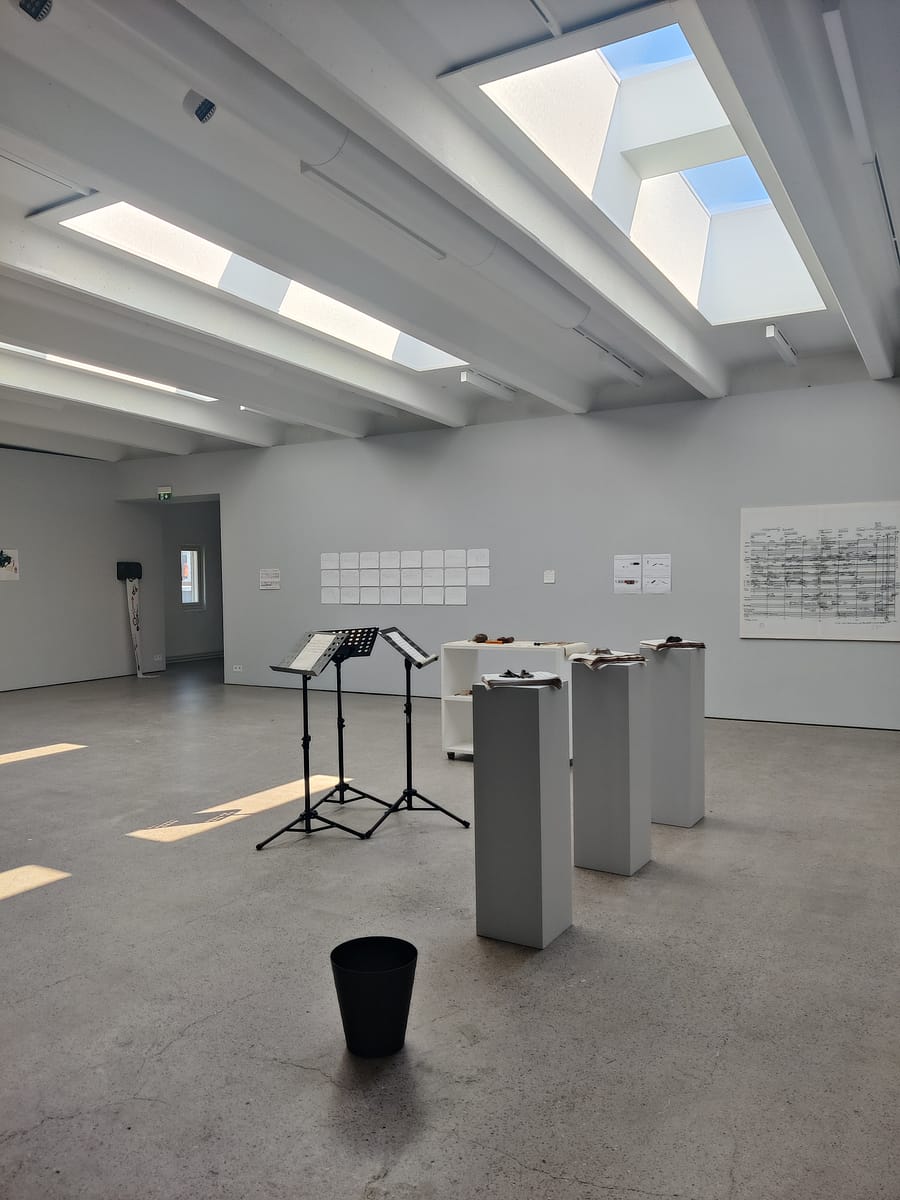
Exhibition view from Yes and NoTations.
On Sunday, 27 July, 13:00–16:00
Screening of Brian Katz’s Vaulted Harmonies: Archaeoconcert at Notre-Dame (2025, 38′)
Performances of selected works from the exhibition Yes and NoTation by the exhibition curators (Charlie Morrow, Livia Schweizer, Oliver George-Brown, Isaac Otto) and their friends.
Opening hours for this exhibition:
Wednesday, 23 July and and Thursday, 24 July: 12.00–20.00 Friday, 25 July – Sunday, 27 July: 12.00–18.00
Support for the exhibition from:
Kohta, The Cultural Fund for Sweden and Finland, Goats & Compasses. Support for the outdoor event from: City of Helsinki, Morrow Sound, NOT Production, Sari Denes Foundation, The Cultural Fund for Sweden and Finland, Goats & Compasses.