Orientating Towards Other Dimensions: Maps, Cut-Outs and Open Horizons in Magdalena Åberg’s New Work
Tidal Passages
At Mont-Saint-Michel, a medieval tidal island in Normandy crowned by a Benedictine abbey founded in 966, architecture carries centuries of history, while the surrounding terrain is continually reshaped by water. As the tide rises around the island, the water reflects the sky, and Mont-Saint-Michel appears like a castle suspended between the sea and another dimension, evoking Laputa, the fantastical floating city of Hayao Miyazaki’s Castle in the Sky (1986).1 Here, the shifting relation between land and water shapes perception and movement, while the horizon and changing light offer direction.
Mont-Saint-Michel thus provides a spatial point of departure for approaching the new works of Magdalena Åberg, a Finnish artist based in Helsinki. It is a place where land and water, access and isolation, interior and exterior, remain in continuous negotiation. These shifting relations resonate with two new large-scale pentaptychs on transparent canvas, presented in her solo exhibition ‘Magdalena Åberg: Folding in Two Dimensions’ (2026), curated by Anders Kreuger at Kunsthalle Kohta. Through windows, openings and painted cut-out forms reminiscent of architectural models, the works lead towards both exterior and interior spaces, carrying their histories with them rather than leaving them behind.
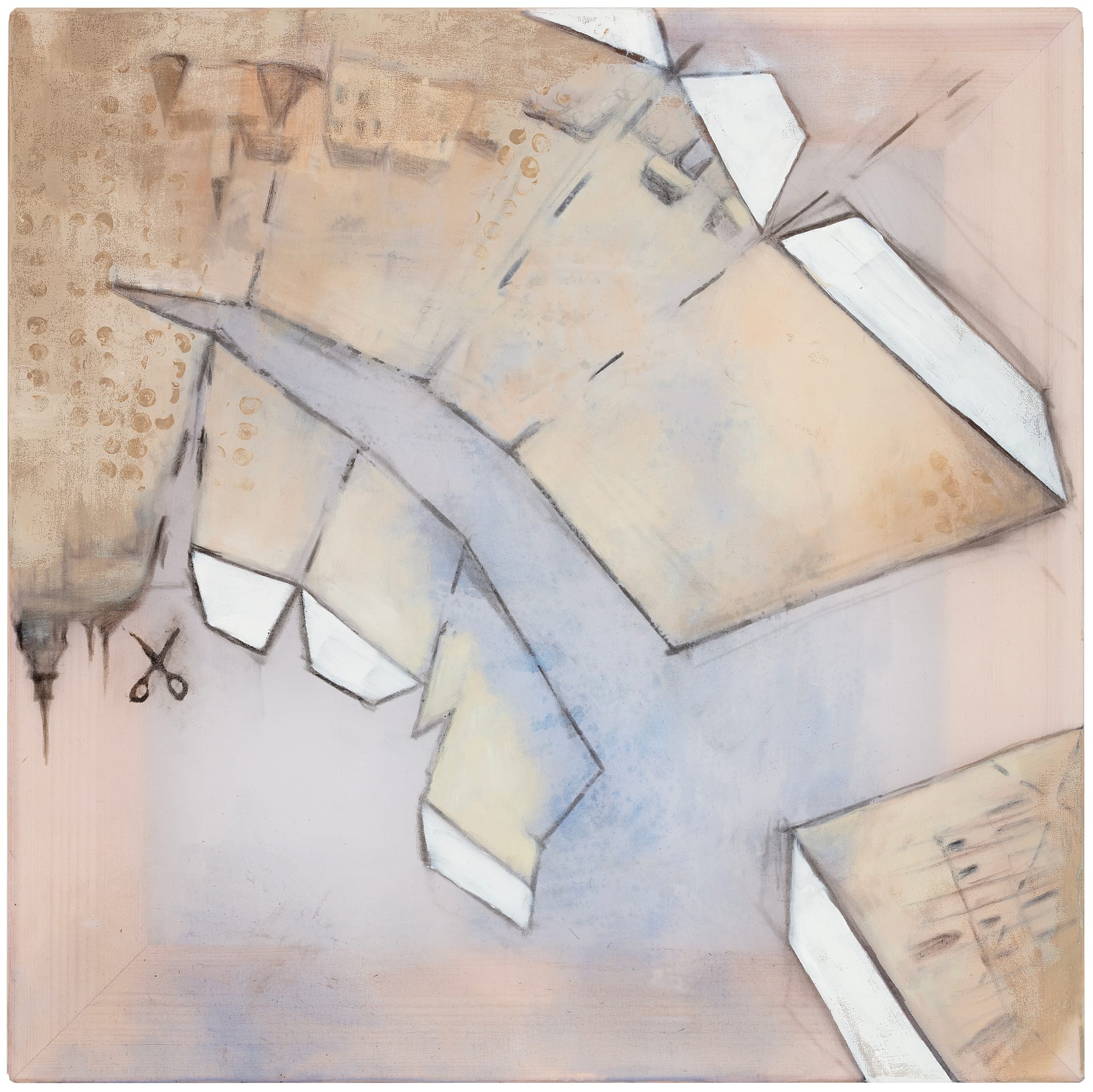
Magdalena Åberg, Mapping Le Mont, 2026. Oil on polyester canvas, 60 × 60 cm. Photographer: Jussi Tiainen
Of the two pentaptychs, Screening Le Mont (2026) offers a direct encounter with Mont-Saint-Michel. The island’s architecture extends across five panels, embedded in a fragmented terrain in which sea and sky merge. Cut-outs and angular forms interrupt the surface, as though a map and its layered histories had been opened, folded and reassembled. The composition feels like an invitation to enter a game: to trace connections between the elements and imagine how they might fit together. At the same time, it unsettles the viewer’s sense of orientation, making it difficult to determine the perspective from which the island and its architecture are seen.
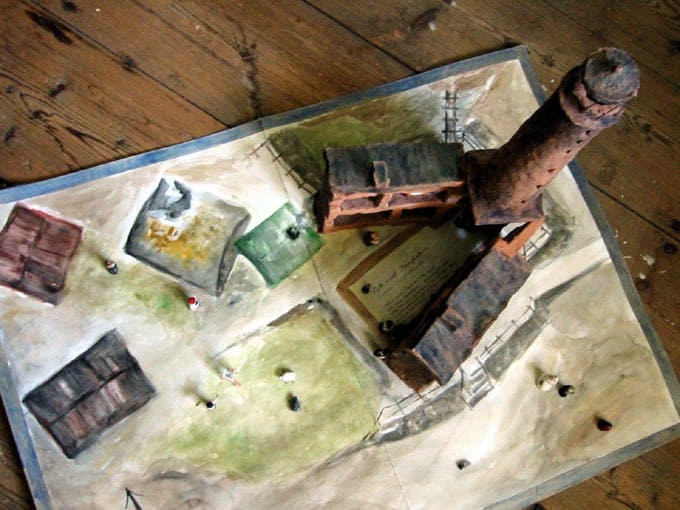
Magdalena Åberg, Fyren/Lek med Bengtskär, 1999. Sculpture for role play, A2 base, the lighthouse model ca 50 cm high
Mont-Saint-Michel shifts between landscape, architectural image and cartographic construction, while the transparent canvas allows light and the immediate environment to enter the composition. Across both pentaptychs, the eye can pass through the transparent surfaces into the gallery beyond. No longer visually contained within a single plane, the images enter a dynamic relationship with architecture, light and the viewer’s moving body. The questions of access, visibility and permeability raised by the works belong to a longer trajectory in Åberg’s practice.
A Journey through Folded Histories
Since the late 1990s, games combining maps and ceramics, such as Coastline’s Changegame (1998) and Play with Bengtskär (1999), have revealed her longstanding fascination with islands and the histories and communities they hold.
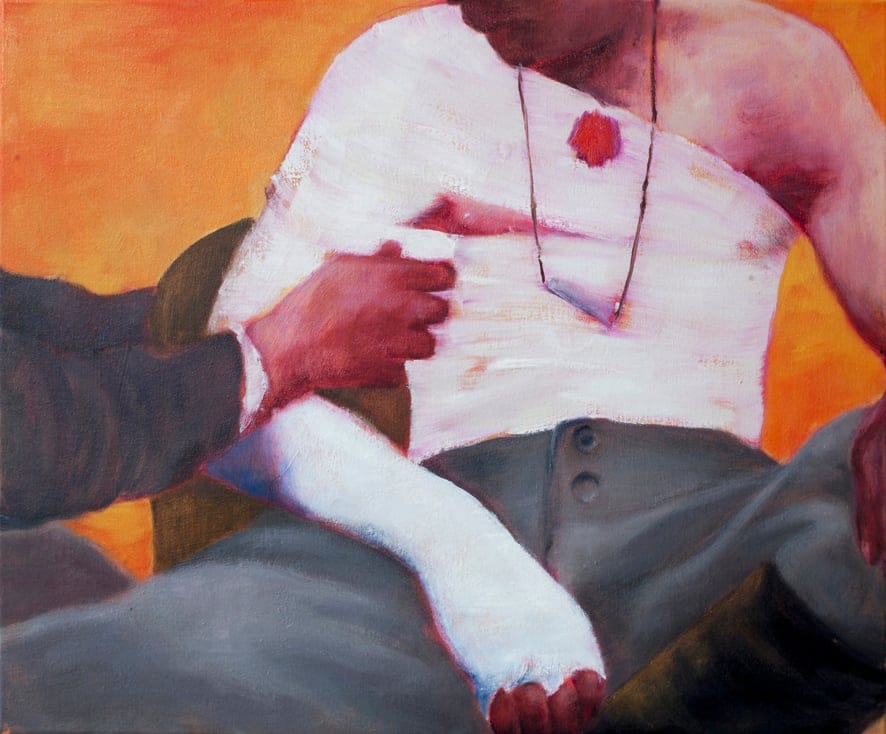
Magdalena Åberg, Välskärin (kertomattomat) kertomukset #33, 2017. Acrylic and oil on canvas, 54 × 65 cm. Photographer: Jussi Tiainen
She subsequently explored enclosure in the series Blinds (2011) and Fences (2015), in which space is restricted and divided, reflecting her observations of the contemporary socio-political climate. Family history came to the fore in Välskärin (kertomattomat) kertomukset – Fältskärns (aldrig berättade) berättelser (2017–18).2 Written in both Finnish and Swedish, the title reflects her heritage and identity and translates into English as ‘The Field Surgeon’s (Untold) Tales’. Through this work, Åberg sought a closer connection with her grandfather by imagining stories from his daily life as a field surgeon during the war, moving beyond national myths of heroism and Finnish sisu.3
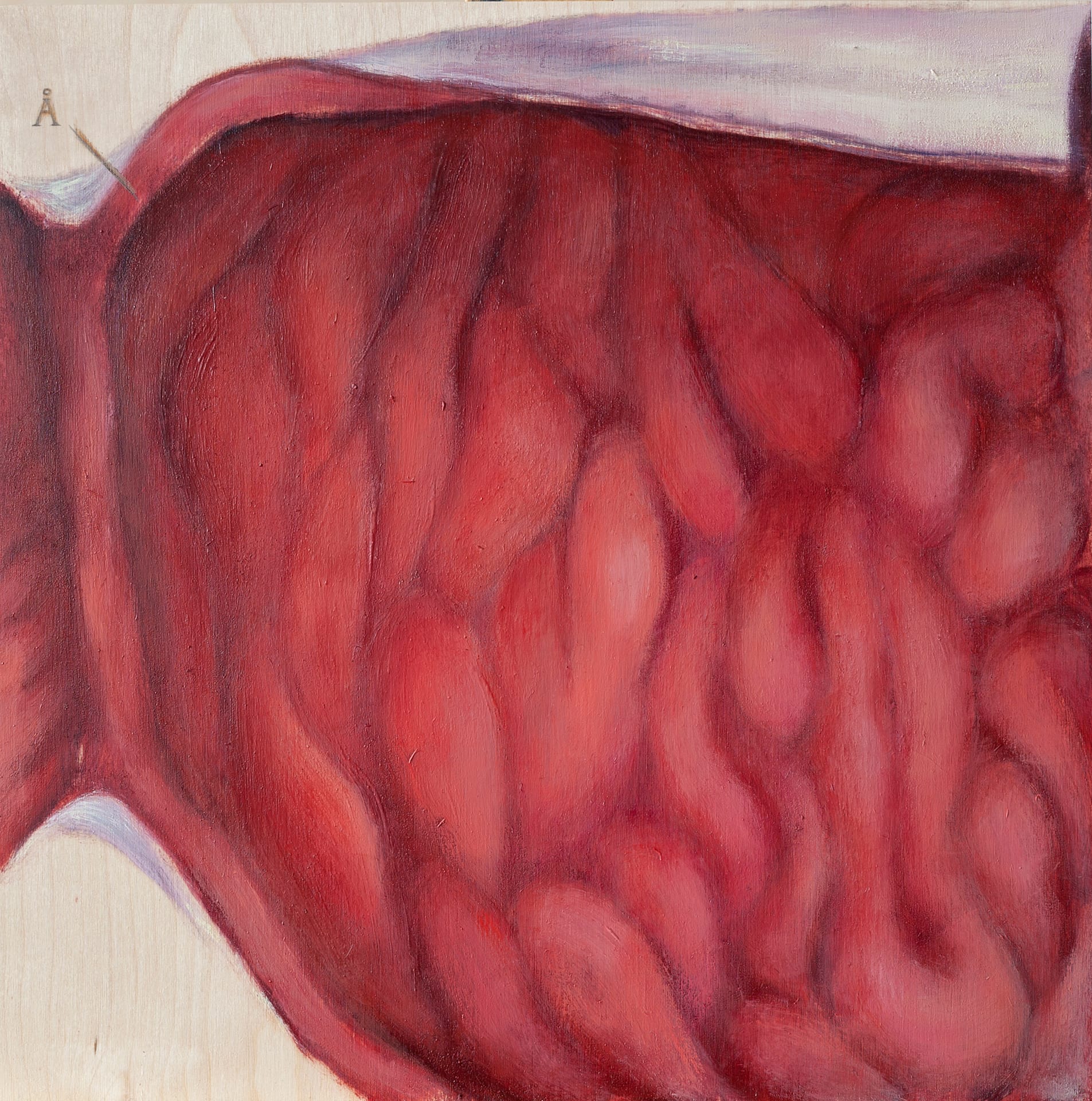
Magdalena Åberg, Interiors #2 (Å), 2018. Oil on wood, 30 × 30 cm. Photographer: Jussi Tiainen
In her series Interiors (2018), Within (2021) and Infested (2025), prompted partly by her mother’s illness, her attention turned towards interior landscapes and the vulnerable territories of the body and mind. In these works, wood brings a particular material weight to illness, inherited memory and bodily experience.
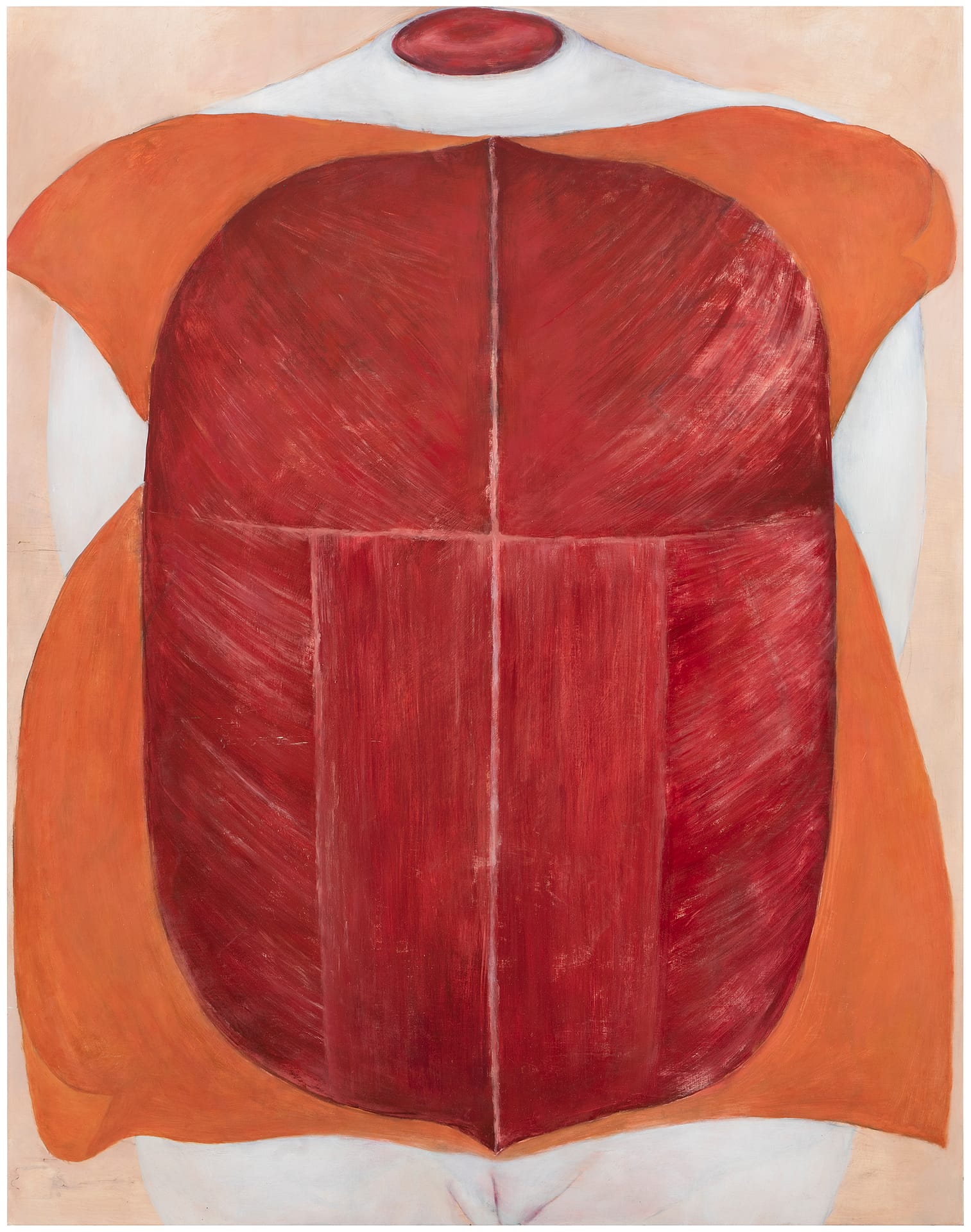
Magdalena Åberg, Within (Découpée), 2021. Oil on birch plywood, 140 × 110 cm. Photographer: Jussi Tiainen
Within this evolving material language, the new paintings mark a shift. Their surfaces become lighter and more permeable, while traces of Åberg’s earlier practice continue to move through them. Histories are folded into the works and reorientated through water, movement, the horizon and light.
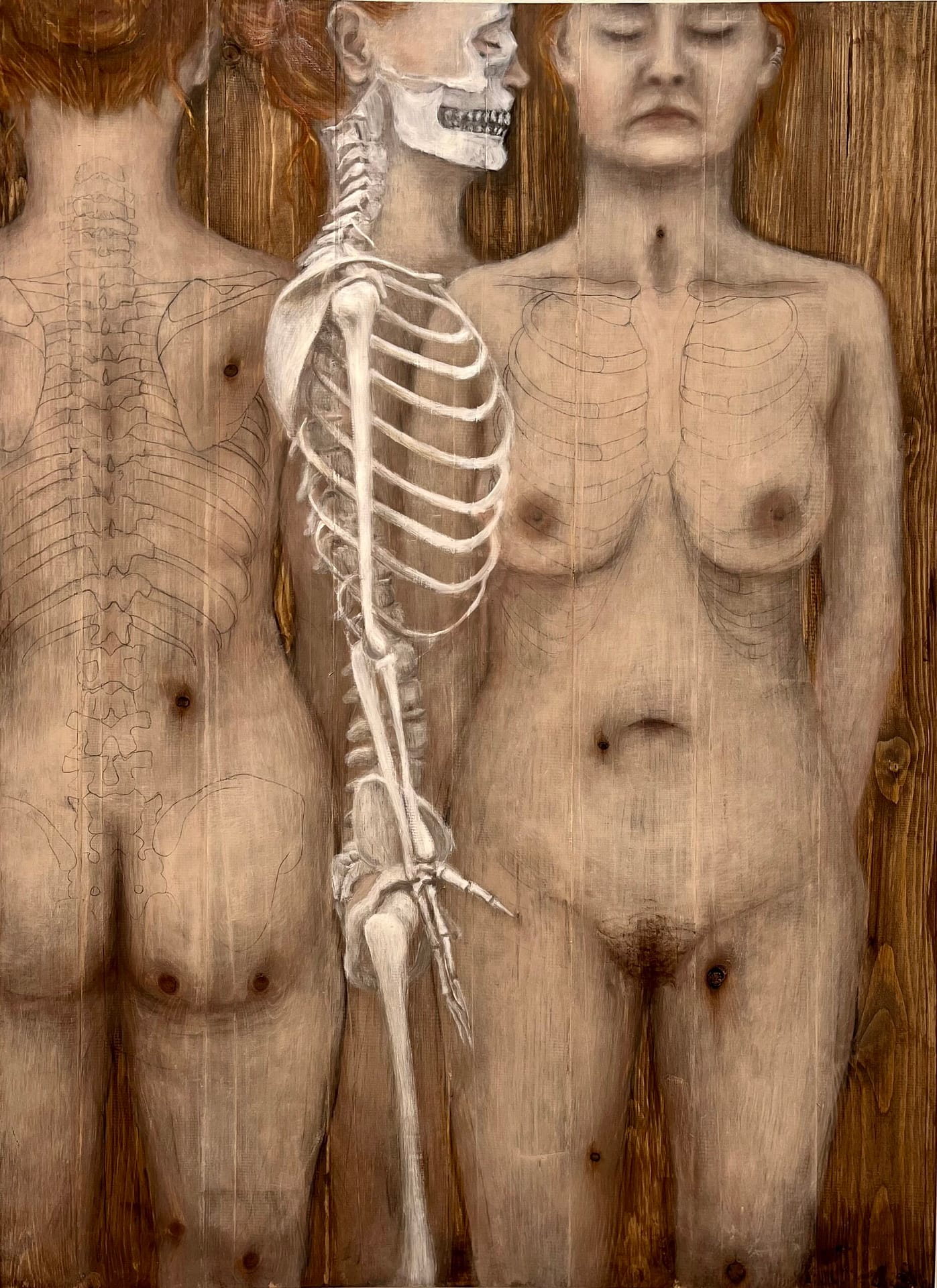
Magdalena Åberg, Infested: Skeleton, 2025. Oil on wood, 122 × 89 cm. Photographer: Jussi Tiainen
What the Map Cannot Hold
The fragmented routes across the paintings bring Åberg’s cartographic thinking into focus. ‘Folding in Two Dimensions’ concerns not only the material folding of a surface but also the map’s impossible task to compress terrain, distance, memory and belonging into a single plane. As Åberg observes, ‘The world is round, so all attempts to show it exactly on a two-dimensional paper must fail. Which means that all attempts are choices, decisions of some sort.’4 A map is often assumed to provide an objective representation of geography; however, mapmaking inevitably involves selection, distortion and omission. It cannot convey the physical experience of moving through a landscape: the effort of the journey, the resistance of the terrain or the mountain that determines one’s route even as it disappears into the flatness of the page.
For Åberg, however, maps are shaped not only by disembodiment but also by displacement. Her fascination with them reaches back to a childhood divided between Finland and Sweden. Sweden was where she lived, but never entirely home; Finland offered an inherited sense of belonging without being the setting of her everyday life. When the family finally returned to Finland, her father remained in Sweden and died shortly after the move. As life continued, his death was given little space to be mourned. Perhaps for this reason, the home they had shared in Sweden remained within Åberg as a kind of true home, even a dream home, although it had not felt that way while they lived there.
The map emerged between residence, memory, ancestry, sense of belonging, and loss, becoming a means of locating the self as much as navigating the world. As a child, Åberg drew maps of imagined places in which a house stood near water, with a sauna by the shore. These were not representations of existing territories but propositions for how and where a life, and perhaps a sense of home might be reassembled.
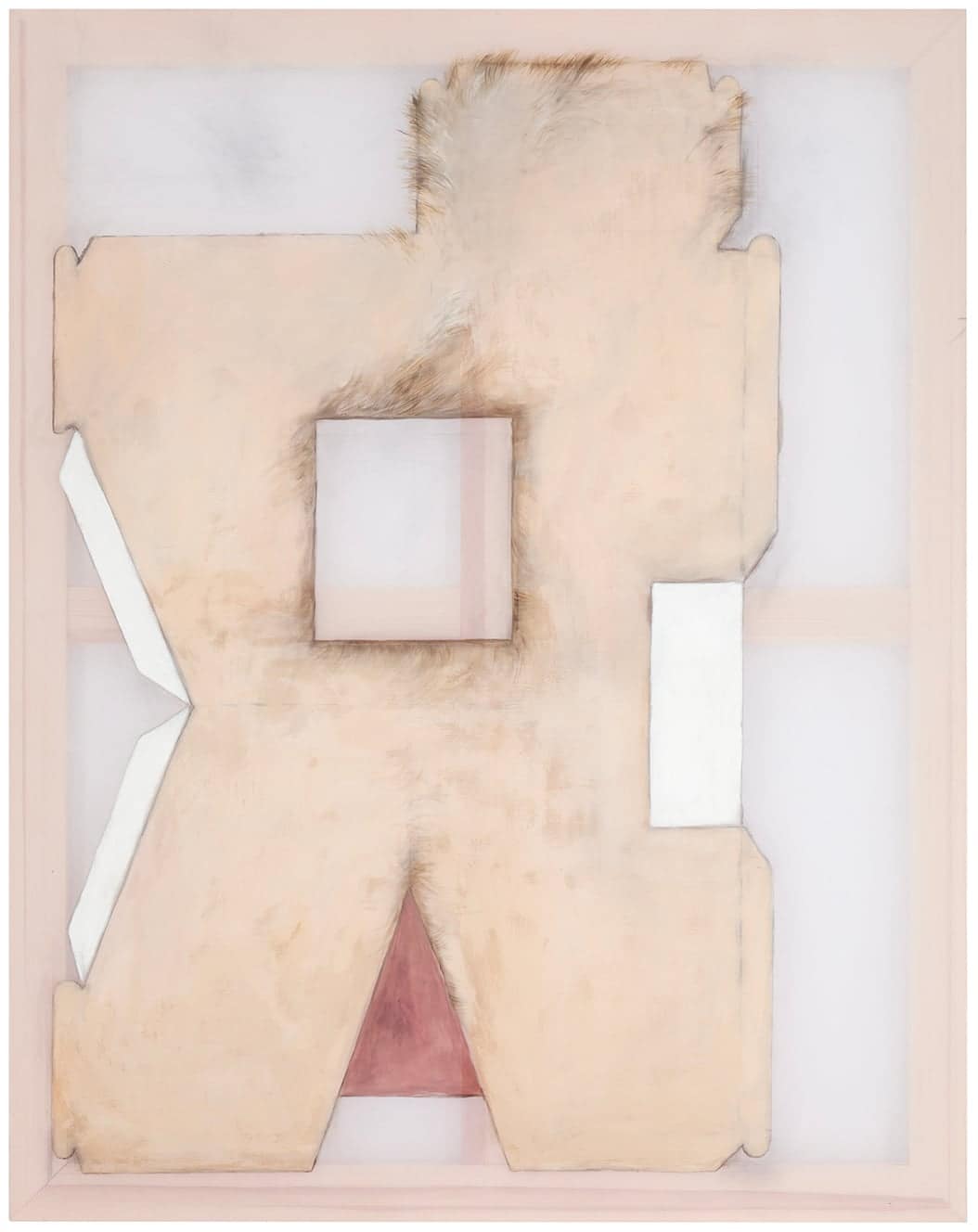
Magdalena Åberg, Folding in Two Dimensions I, 2026. Oil on polyester canvas, 140 × 110 cm. Photographer: Jussi Tiainen
This interplay between factual accuracy and imaginative freedom continued in Åberg’s later relationship with mapping. While drawing maps for a Helsinki newspaper in the 1990s, she had to provide functional clarity: streets, distances and the locations of events needed to be immediately legible. Cartography became interpretative again in the bilingual cultural-historical guide Kvinnornas Helsingfors – Naisten Helsinki (2010)5, in English ‘Women’s Helsinki’, published in Swedish- and Finnish-language editions. Adopting a women-centred perspective, the book foregrounds women’s presence and voices in Helsinki’s social, cultural and spatial history. Åberg helped to plan the publication, contributed a text on street galleries and created its maps. Helsinki remained recognisable in scale and orientation, but each map responded to the particular history or perspective explored in the accompanying essay. In Åberg’s artistic practice, mapping would later extend beyond external geography to encompass the interior territories of the body and psyche.
For one of these maps, Åberg used a scan of painting canvas. A support traditionally associated with painting became the ground of cartography, while the map itself became, in her words, ‘a bit like a painting’.6 Canvas, map and image fold into one another, crossing the boundary between medium and representation. This exchange returns us to the transparent paintings. Just as a map’s visible surface cannot disclose the full terrain it claims to represent, their translucent surfaces suggest spaces and histories that remain beyond view. The surface becomes less a boundary than a threshold between visible and hidden dimensions.
Skin, Threshold and Other Dimensions
This threshold acquired a bodily dimension when Åberg began working with the new material while recovering from hand surgery. In the resulting works, transparency functions at once as skin, threshold and spatial condition. These concerns take a more oblique form in the second pentaptych, As Eve Said to the Serpent (2026). White-painted apertures punctuate the surface, some recalling doorways or windows oriented vertically or horizontally. Together, they introduce a sense of play while suggesting points of passage into or out of some other dimension.
The degree of permeability remained an open question throughout the making process. Partially veiling the view through the painting, the membrane makes its surface appear by turns planar, folded and layered. When the work is displayed freestanding rather than against a wall, the apertures frame glimpses of its surroundings.
Together, these cut-outs, openings, translucent surfaces and shifting depths invite speculation about what might lie beyond. What does it mean for a work to open onto the unknown? Does an opening draw the viewer into an interior, lead out into the world beyond, or offer access to a realm imagined by the artist?
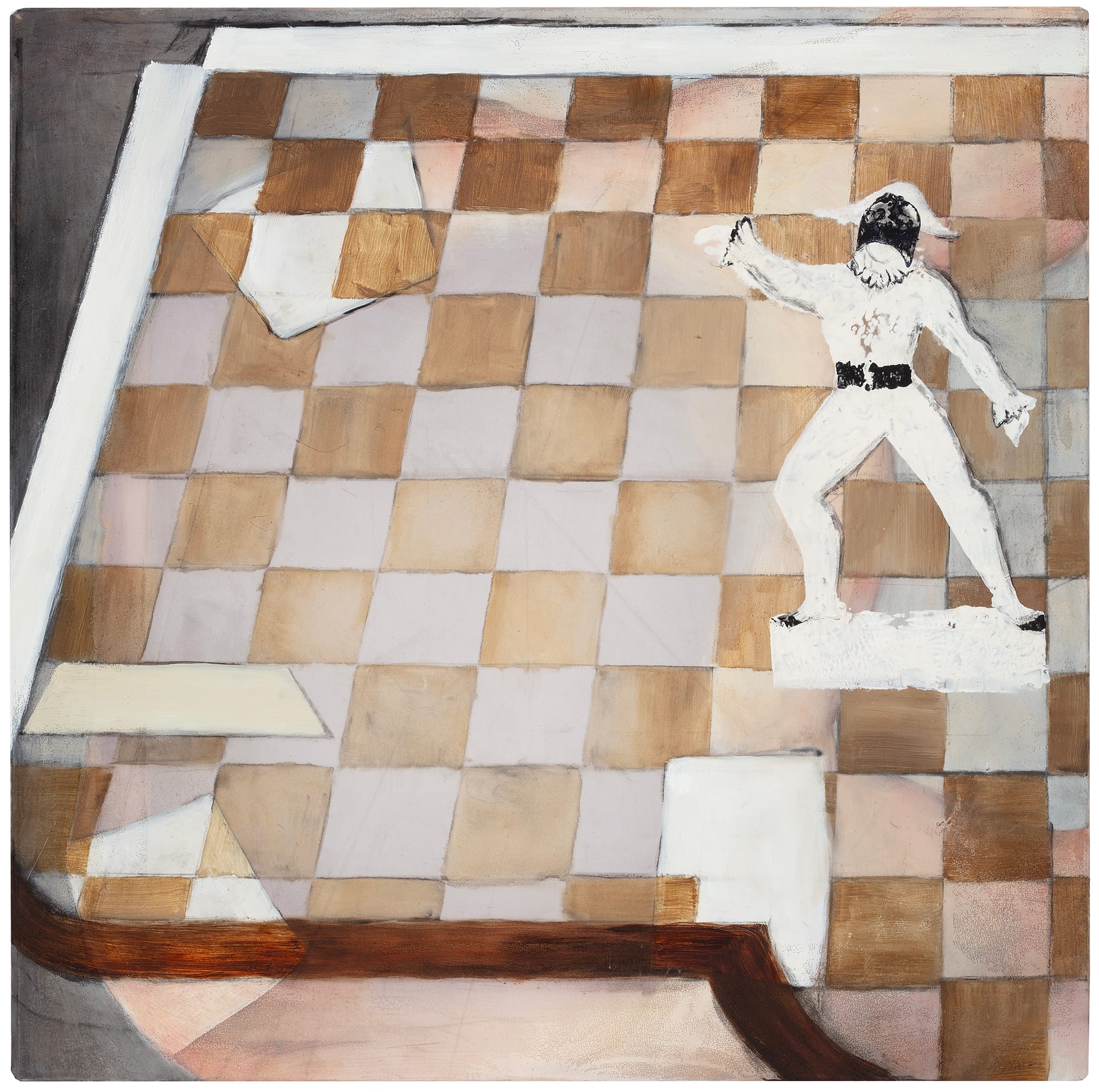
Magdalena Åberg, Crusaders and Comedians, 2026. Oil on polyester canvas, 50 × 50 cm. Photographer: Jussi Tiainen
The Tree, the Body and the Sea
While the openings draw the eye beyond the painted surface, a closer reading returns it to the imagery held within. An apple tree rises from a mountain whose form recalls the cliff at Golgotha. Although Åberg does not consider herself religious, she has long been fascinated by the French painter Enguerrand Quarton’s Le Couronnement de la Vierge (1453–54), in which the Virgin ascends above scenes of Paradise, Purgatory and Hell, while Christ is shown crucified on the cross below.8 Åberg enlarges the small Golgotha cliff in Quarton’s painting, transforming a marginal detail into a central structure within her own work.
The apple tree can also be read alongside Rebecca Solnit’s As Eve Said to the Serpent: On Landscape, Gender, and Art (2003).8 Åberg had already painted the tree when she encountered the book, but Solnit’s ideas gave language to connections already emerging in the painting and ultimately inspired its title.
For Solnit, landscape is not merely physical terrain but the ground upon which personal, social and political life takes shape. Solnit’s interweaving of landscape, body and art resonates throughout Åberg’s practice, in which body and terrain are not simply analogous but deeply integrated.
This integration of body and terrain becomes visceral beneath the tree, where a root system coils across the mountain, hovering between botanical growth and the intestinal forms within the body – a recurring motif in Åberg’s Within and Infested series. Dotted lines surrounding some of the openings resemble stitches, bringing the image closer to the body and the experience of healing after surgery. Bodily repair becomes a visual and structural language: stitches join, support and construct without erasing the evidence of rupture. Healing remains an ongoing process rather than a completed state.
Solnit’s writing also sheds light on an ambivalence that Åberg has felt for as long as she can remember: the desire both to put down roots and to move nomadically towards the horizon. Åberg recalls Solnit relating this tension to the upright human body, which retains something of the tree in its vertical form while remaining free to move across the landscape. This pull between rootedness and movement can be felt throughout Åberg’s practice – in her recurring need to draw maps and in her search for openings, passages and points of access. The apple tree brings these opposing impulses together: anchored in the mountain, it nevertheless reaches outwards into open space. Rather than resolving the tension, it gives form to a state of suspension between staying and leaving, belonging and freedom.
The tree also carries feminist symbolism shaped by Solnit’s writing. Åberg is drawn to Solnit’s reading of Eve as ‘the clever one’, a figure receptive to knowledge and open to the new. The story is reclaimed as one of curiosity, appetite and openness, with Eve’s desire for knowledge understood as a source of agency rather than shame.
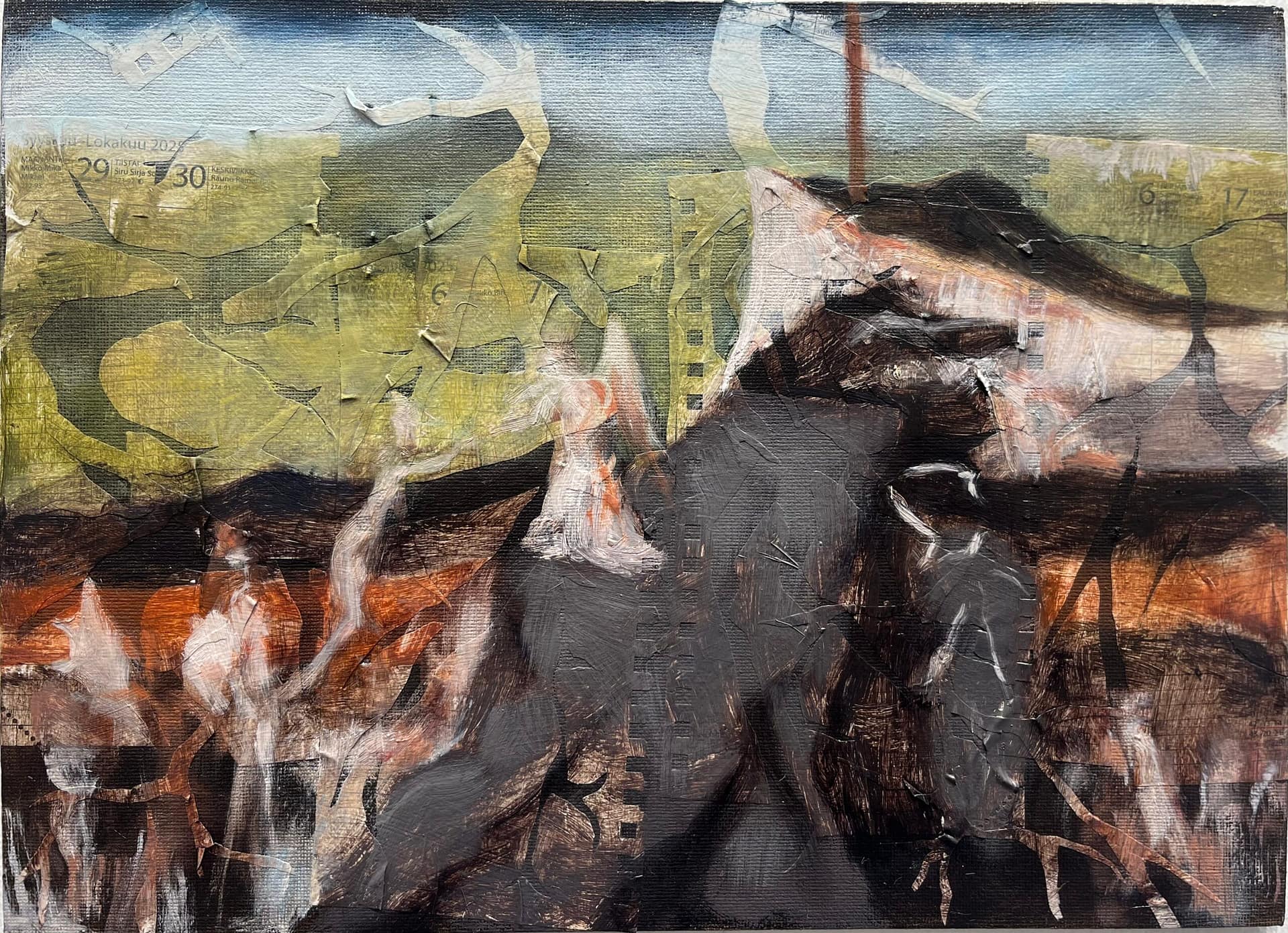
Magdalena Åberg, Netherland, 2025. Oil on canvas mounted on cardboard, 24 × 33 cm. Photographer: Jussi Tiainen
Following the vertical structure of the pentaptych, the eye descends from the tree towards the sea. In place of the damned bodies found in Quarton’s painting, Åberg introduces sea monsters drawn from historical maps, transferring their printed impressions onto the canvas. Hell is no longer confined to an imagined afterlife but enters the conditions of the present: rising waters, Finland’s maritime geography and a shared sea marked by the proximity of war. Amid dotted paths and barbed-wire-like lines, might the openings offer escape or passage towards safety?
The work does not, however, settle into pessimism. Åberg is drawn to the choice and potential for rescue contained within the original image: ‘There is a path you can choose. Perhaps you can also be thrown down, but you can absolutely be helped up again.’ The threat of descent is countered by choice, care and rescue.
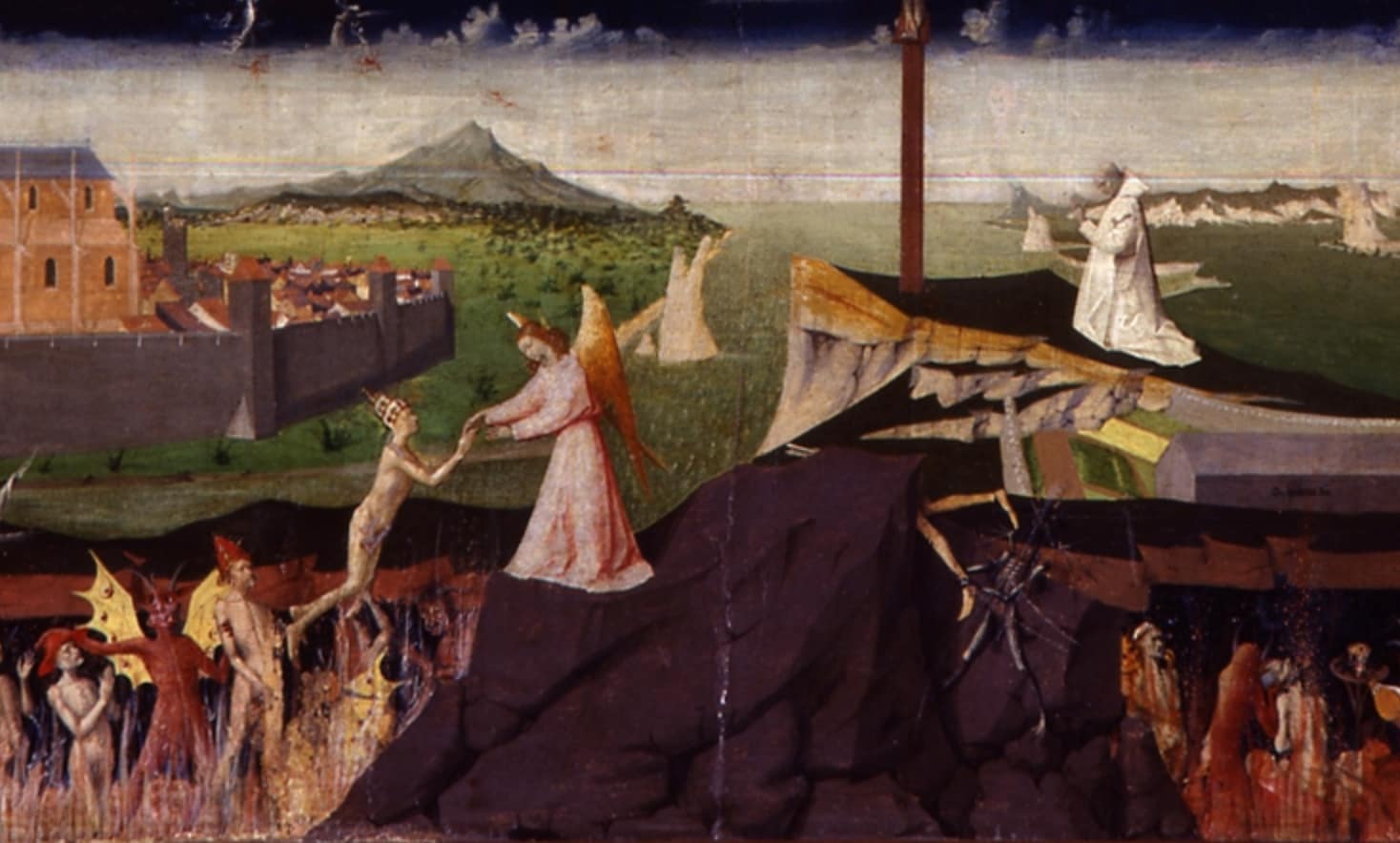
Enguerrand Quarton, La Couronnation de la Vierge, 1553–54. Tempera on wood, 183 × 220 cm, Musée Pierre-de-Luxembourg, Villeneuve-Lès-Avignon (detail)
The openings themselves resist fixed meanings. Åberg tentatively associates one such ‘window’ with heaven while allowing it to remain open to interpretation. It operates as a threshold between image and architecture, closure and openness. Through the skin-like surface, sea, body, image and gallery space momentarily pass into one another. As points of passage, the openings acquire political and bodily force: they counter fences, borders and the enclosed garden while answering a visceral need to see out, breathe and retain access to the horizon.
Open Horizons
Åberg follows the work as it takes shape rather than determining its course in advance: ‘I can’t be so planned.’ Her process responds to the moment, while visible brushstrokes and areas of exposed canvas convey a sense of transition. Her statement ‘I want to have some openness in it’ describes both a formal principle and her present artistic position – a point from which the work can continue.
This open-ended quality extends to letters such as A and B that appear beside the cut-outs, suggesting sequences or instructions and evoking a map leading from one point to another. Yet these sequences remain unfinished: a work may contain only two letters, not necessarily beginning with A, leaving the next step undetermined. Rather than directing the viewer towards a single destination, they allow the image to extend beyond its plane into other dimensions and unfold through the perceptions and experiences of those who encounter it. The way forward remains uncertain, but not without direction. For Åberg, opening a window onto the horizon answers an existential need: amid changing light and moving waves, looking into the distance allows the world to expand and hope to endure.
Notes
1. Hayao Miyazaki, Castle in the Sky (Tokyo: Studio Ghibli, 1986), animated film.
2. The title references Zacharias Topelius’ classic novel about the history of Finland, Fältskärns berättelser, first published in 1853–57.
3. Sisu is ‘a Finnish cultural concept that denotes determination and resoluteness in the face of adversity.’ Pentti Henttonen and others, ‘A Measure for Assessment of Beneficial and Harmful Fortitude: Development and Initial Validation of the Sisu Scale’, Heliyon, 8.11 (2022), e11483 (p. 1).
4. Magdalena Åberg, ‘Women’s Helsinki’, https://www.aberg.fi/womens-helsinki , accessed on 20 May 2026.
5. Anna Byström, Rita Paqvalén and Hedvig Rask, eds, Naisten Helsinki: Kulttuurihistoriallinen opas, trans. Riie Heikkilä and others (Helsinki: Schildts, 2010).
6. Unless otherwise indicated, all quotations from Magdalena Åberg are taken from an interview with the author conducted on 17 May 2026.
7. Enguerrand Quarton, Le Couronnement de la Vierge (1453–54), tempera on wood, 183 × 220 cm, Musée Pierre-de-Luxembourg, Villeneuve-Lès-Avignon.
8. Rebecca Solnit, As Eve Said to the Serpent: On Landscape, Gender, and Art (Athens: University of Georgia Press, 2003).