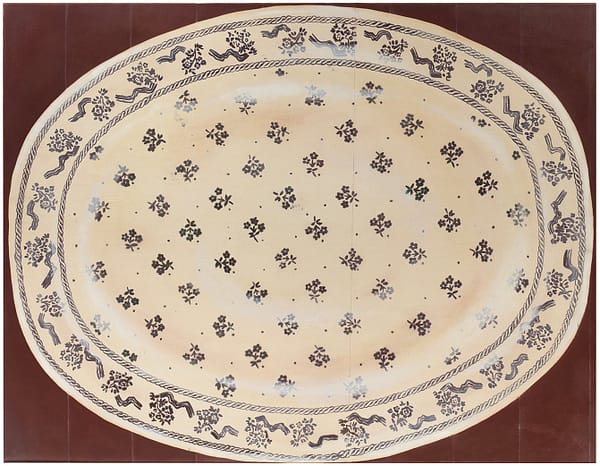
It passes through at regular, but somehow unpredictable intervals; or, when I hear it coming, it is both completely unexpected, and always right on time. Some describe it has having a softer, shuffling kind of cha-cha-cha-cha-cha-cha-cha-cha. For my part, I always hear a guttural undertone, not quite in sync with what everyone can agree is a rhythmic pattern: something like cha-chaguh-cha-cha-chaguh-cha-cha-guhcha-cha-chaguh. But even that doesn’t quite do it justice. I can’t mimic it all by myself. We might need a choir.
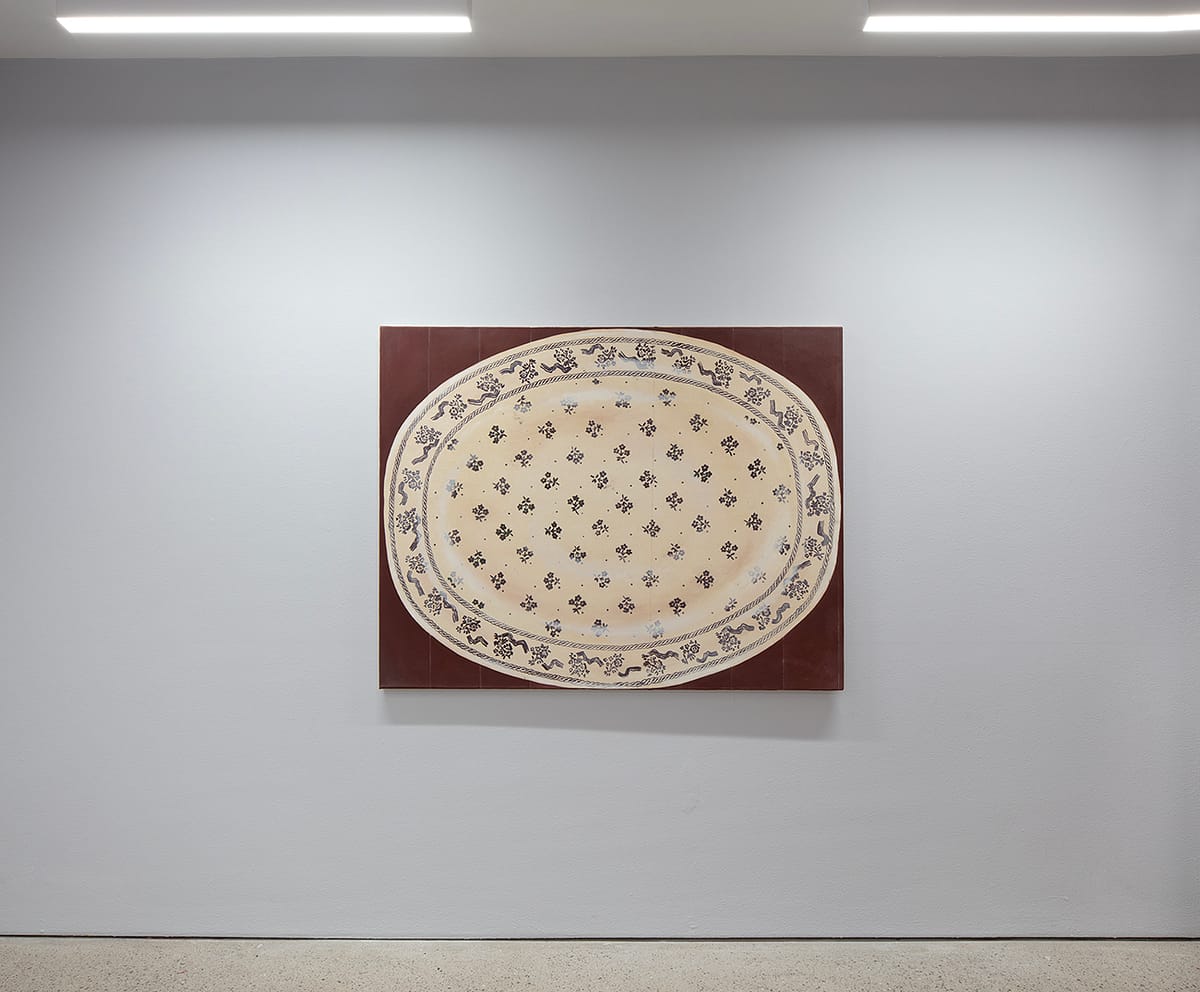
Iiris Riihimäki, Mother’s Lore, 2024, oil on sewn-together canvases, 155 × 120 cm. Photo: Jussi Tiainen
I went down to the village today, to visit the living diorama. Apparently it started a decade ago as a very ambitious mannequin challenge. 379 adult and adolescent human beings frozen mid-gesture, a typical afternoon of the mid-2010s stuck in invisible amber. The fishmonger’s cleaver is raised high above the trout’s head, the fish given eternal reprieve; a pair of teenagers have been in a squat position for the better part of their twenties, one about to roll a pair of dice, unaware of the other’s hand slyly picking his wallet. Why it keeps going is unclear to me: perhaps due to some ancient rivalry with another, distant village. Even if this competing tableaux vivant disbanded years ago, it is unclear how this news would ever cross the valley.
It was miserably cold this morning by the time I reached the first houses of the village. Arriving at the town green, I weaved among a small cluster of middle-aged humans permanently in upward dog position. A light November snow had fallen on their backs and turned-up faces, melting into wet patches on their tank tops and T-shirts, appearing like sweat. The designs and logos of their active wear have been a source of speculation for me over the years: the aspirational brand, the old set of pyjamas, the ex-hippie are all stock characters in the drama unfolding in my head. Sometimes I even forget they can hear me, as I mutter to myself walking by. Despite the town’s total motionlessness, or perhaps because of it, the narratives continue to change. From the gesture the hunter seems to be giving the baker, it once seemed a romance was beginning to blossom. But more recently this interpretation has fallen out of favour. Is his gaze not more wistful than wily? The once freshly-killed hare slung over his shoulder is no longer looking so fresh. Surely this is the waning moment, when desire lies broken beneath the victorious status quo ante. And so the interpretation evolves to match the conditions of the present. In a few months they will probably be at war, the hunter’s clutch on his rifle dangerously close to the trigger.
Some say it sounds like a threshing machine. It always sounds as if just tracing the horizon. If it is a machine, it leaves neither tracks nor chaff in its wake. If you turn towards the sound, it will shift slightly off-centre; you can never hold it in focus. The hills are bare save for a thin frost.
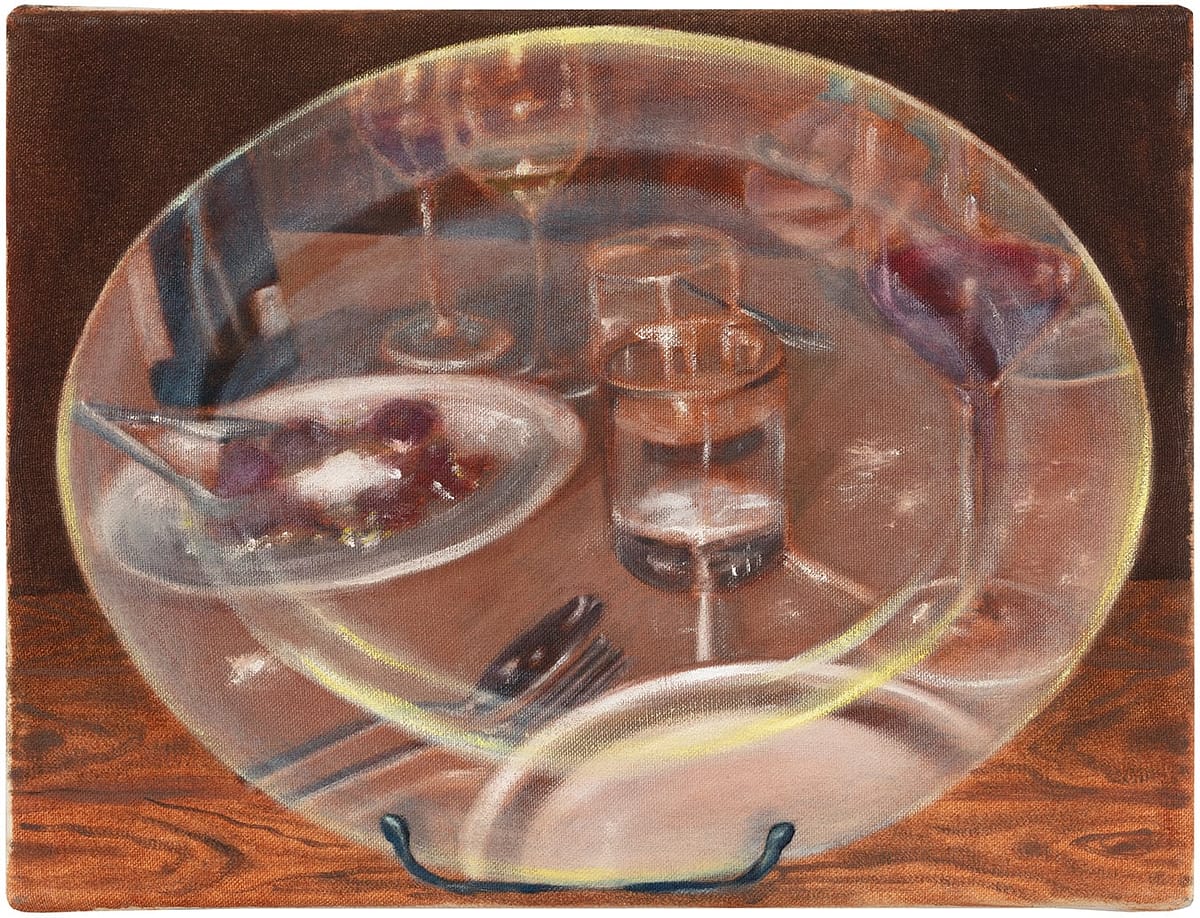
Iiris Riihimäki, Diamond Industrial, 2024, oil on canvas, 30 × 40 cm. Photo: Jussi Tiainen
The villagers took their final movements on a beautiful spring day in late May. Perhaps it was from an overwhelming sense of optimism that they chose to freeze themselves in place on such an auspicious afternoon. Everyone had completed their taxes for the year, and was ready to settle into a summer of total stillness. The town accountant, in fact, was already on vacation. She was informed via text, in no uncertain terms, that she should remain on indefinite holiday until the villagers stirred once again. Cha-chaguh-cha-cha-chaguh-cha-cha-guhcha-cha-chaguh.
Some say it is the spinning of the Dharma Wheel.
Some say it is the continually ripping seam between the ongoing present and the future.
Because the sound began more or less around the time that the village stopped, some say that it was always there: it was simply too faint to hear above the bustle of life. The educated people believe this. They point to the famous story about John Cage, insisting that the softer, higher-pitched tone is the sound of the villagers’ nervous systems, and the lower, glottal noise is the blood pumping through their veins. This explanation is very logical, even scientific, although it has so far eluded scientists, who seem unable to measure the sound on any device. Personally, I think it is an echo, whose origin is lost to time. Perhaps it was the explosion of Krakatoa, or the crack of the hunter’s rifle that morning, the one that killed the hare. In any case, it is not fading away as all echoes should. It grows louder with each turn through the valley.

Becket Flannery is a writer and artist based in Amsterdam since 2016. Prior to that, he lived in Los Angeles, where he received his MFA from the University of Southern California. Becket has written in response to the practice of other artists since 2014 in modes that include fiction, poetry, and essays, using the exhibition’s ‘paratextual spaces’ as sites for his dispersed writing practice. He also works as an art critic, primarily at the Netherlands-based platform Tangents, where he is an editor. As an artist, Becket exhibits under the name Becket MWN. His projects both serve as close readings of media and images, as well as extensions of and speculations on them. Examples of these include: the structure of a sitcom house; ‘twinning’ in film; a fictional blood rave. His practice primarily takes the form of exhibitions, which may include spoken and printed text, sculpture, installation, or performance.