Rhythm – as we commonly understand it – appears to introduce into this eternal flow a split and a stop. Thus in a musical piece, although it is somehow in time, we perceive rhythm as something that escapes the incessant flight of instants and appears almost as the presence of an atemporal dimension in time.
– Giorgio Agamben1
We all exist in time but have vastly different experiences of it. For some, time moves too fast, for others painstakingly slow. To deal with temporal overwhelm, some develop a codependence on narrative and linear progression, whereas others seek solace in the cyclical. There are those who look at time as something to be conquered and reflect on the passing of time through ritual, and there are those whose lives are excluded from the prevalence of ritual, whose experiences play out within less stable, more malleable and interminable gaps.
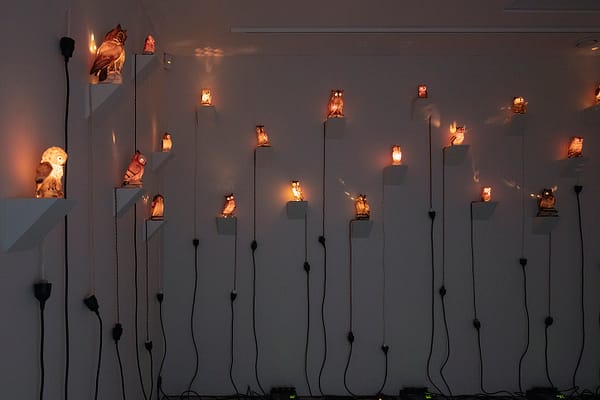
Oscar Eriksson Furunes’s night watch derives from a genealogy of individuals who across several decades have engaged in the obsession of searching, finding, collecting and preserving perfume lamps shaped as owls, joining a somewhat eccentric network of enthusiasts. These types of porcelain perfume lamps were produced in Central and Western Europe from the early twentieth century until the 1990s. They have small inbuilt pockets for perfume and were originally used to cover up the smell of cigarettes in smoke-filled bars. The samples in Furunes’s possession exist in and out of sight, either as part of iterations of night watch when the work is on display or as part of his collection of approximately 170 lamps, which is now gradually being dispersed as the work is acquired by different public collections.
His work often begins with the act of collecting objects whose status as a work of art is far from pre-determined. In contrast with, say, an empty canvas stretched in anticipation of becoming a painting, the materials in Furunes’s work have their own manufactured objecthood. Their ‘formal’ qualities reveal themselves to him over time, often as a catalogue of human gestures. This is no passive act of waiting for form to emerge; it is highly physical.
In particular, night watch has come into being through tireless online searches, physical travel and the forging and maintaining of relationships with an array of collectors and eye-witnesses across Europe. Therefore night watch is at its outset already a collaborative work. As much as Furunes has collected objects, he has also collected time. This translates into an less acknowledged aspect of the work, which is usually read as adjacent to sculpture rather than to time-based practices.
night watch becomes a ‘time piece’, but it also acquires relational qualities because of the owl lamps’ specific history. They were used as a warning signal and were switched on to warn patrons of underground gay establishments in Amsterdam of the incoming threat of strangers, policemen and assumed heterosexuals. The work becomes a testimonial and an ode to the history and loss of such meeting places, as well as a tribute to night as a time and place that seems to exist outside the realm of the ‘normative’ and of how it is being policed.
The dissemination of Furunes’s work has often centred on this narrative. It makes his practice legible as part of established historical readings of gay spaces as sites of subversive joy and pleasure, paired with very real physical and social danger. Although true, it positions the significance of space over time as the work’s main conduit. Nevertheless, time – the ability to pay attention to it and read it precisely, and the fear of ‘blinking and missing it’ – is an important part of what the work is reanimating.
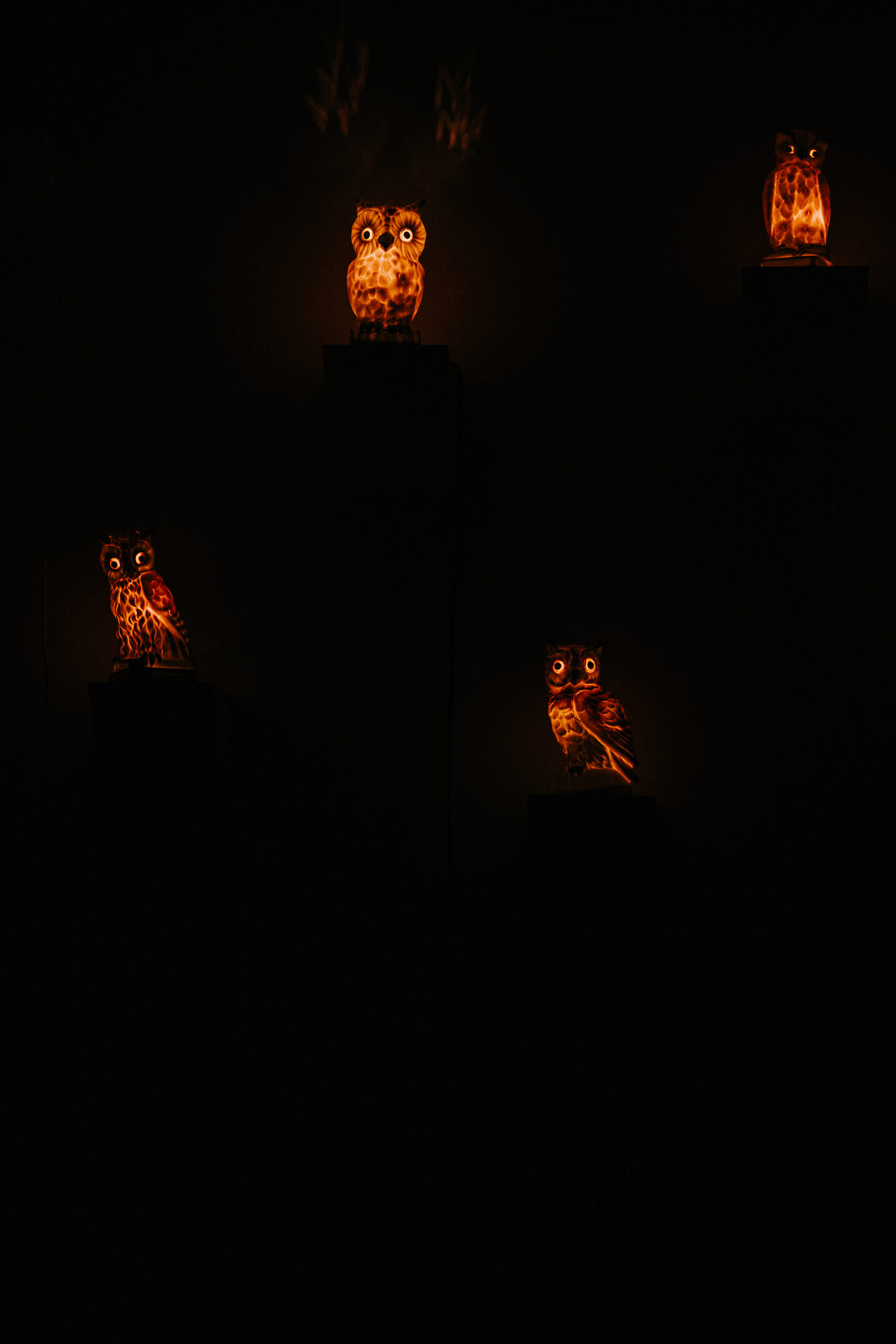
Oscar Eriksson Furunes, night watch, installation view from KHM Galery, Malmö. Photographer: Youngjae Lih
When describing the structure of a work of art, we often attribute it to its medium and physical dimensions. We less often attribute this structure to immaterial qualities, to what is not visible to the naked eye but deeply felt in the encounter with the work. night watch reveals itself once we let go of fixating on the objects themselves and pay attention to its sensorial aspects: the discreet scent of crystallised perfumes the owl lamps will occasionally emit, the composition of the Morse code signalling, the way it doesn’t reveal where the auratic sequences of glowing and dimming ends and begins, nor whether it has any beginning or endpoint at all.
Furunes has made no effort to conceal the electrical mechanisms which allow this code to be transmitted to us across time, quite the opposite. While the owls are all distinct – none are identical within each iteration of the installation – the work becomes increasingly about their communality, as the sound of the electric buzz pulsates when they take turns in communing with us.
Because I first saw night watch in highly social settings, my relationship to the work was mainly filtered through the spatial and conversational awareness of others. So it was during my third encounter with the work, in a large room all by myself, that its temporal characteristics became apparent to me. Having been previously wrapped up in the ethereal appearance of the owls as individual objects, I now caught myself being more involved in the work as a whole. I was becoming enmeshed in a desire to ‘see all of it’, to experience whatever I imagined was the totality of coded electric light patterns.
Yet as I related to night watch for the first time as an artwork that demanded my time to reveal the fullness of its own, it quickly became apparent that the haunting light sequences and low-humming electrical buzz that accompanies them are created to loop without a discernible beginning, middle or end, mirroring the work’s ‘unfixable’ placement in historical time. In one of our conversation, Furunes wonders out loud what effect it has to prolong a ‘warning signal’, thereby taking it out of its original time and place. My response is that it confronts us with the warning as a present spirit.
As the work has travelled, the mathematical systems used to compose its lighting ‘scores’ have also taken different forms in accordance with the varying scales of each installation. At Kohta in Helsinki, where the audience’s peripheral vision played a bigger role, and where the space itself insisted on a more intimate distance between the work and its viewers, the score was slowed down in comparison to the edition for Kunstnernes Hus in Oslo, or K-U-K in Trondheim.
To modulate night watch’s carefully calibrated cycle of self-sustaining time, tension, and beat, Furunes has collaborated on the piece with his in-life partner Juho Antti Eerola, a Finnish musician and artist. Together they have created another strand of relationship between the work, the history it represents and their own domestic life. Oscar laughs and tenderly recounts how he has called Eerola countless times to share his excitement over the acquisition of a new owl lamp, and how they live with several defunct ones, which for technical reasons can’t become part of night watch, in their apartment in Helsinki. Through his recollections, Oscar’s personal investment in the work keeps gaining translucence. And with all of this revealed to me, I can finally understand why my own interest in the work has increased the longer time I have spent with it.
When I finally leave the room, I long more to see and be seen by night watch than when I walked in.
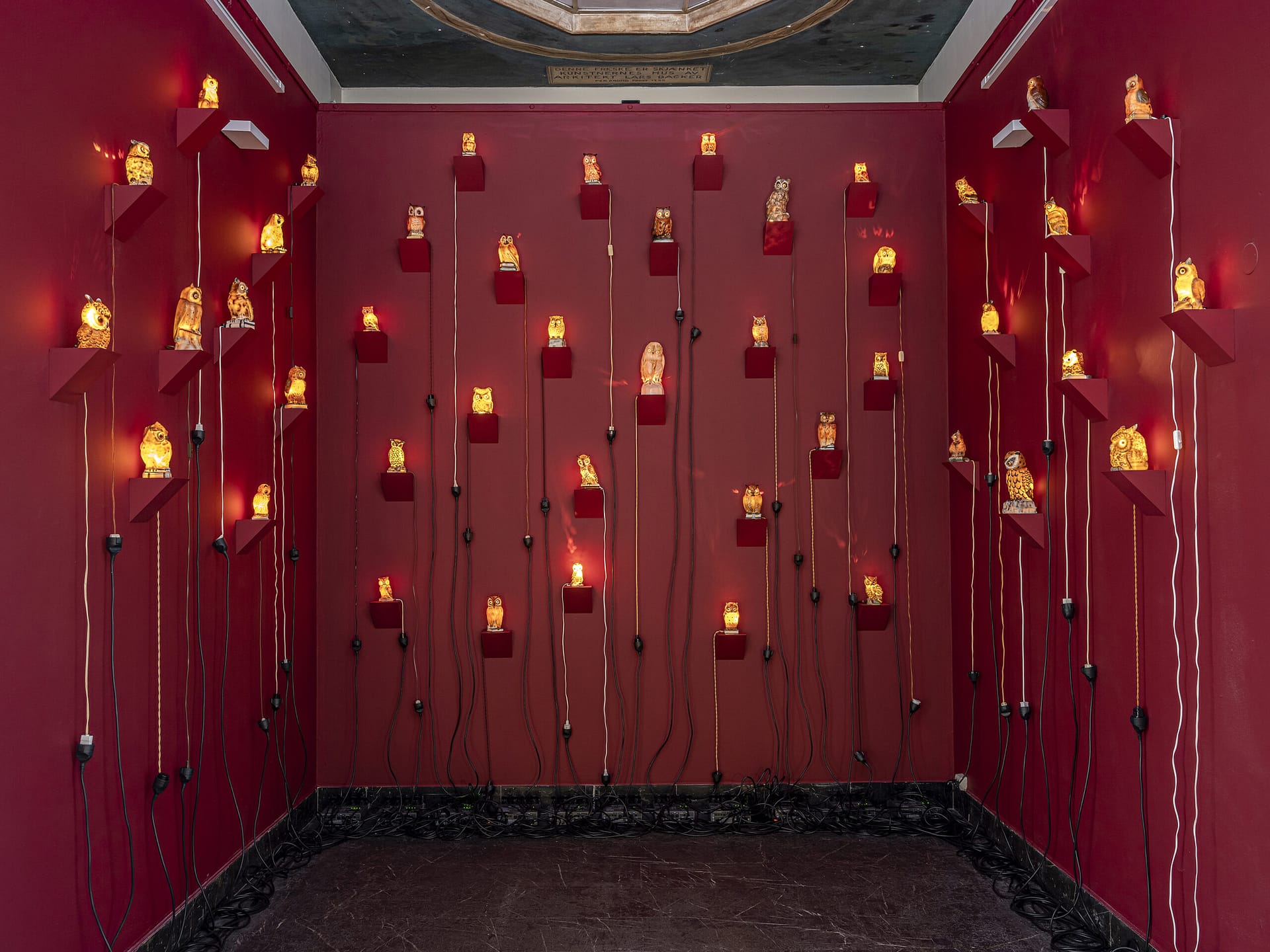
Oscar Eriksson Furunes, night watch, installation view from Kunstnernes hus, Oslo. Photographer: Vegard Kleven
Ever since I first encountered Elizabeth Freeman’s argument for foregrounding bodily pleasure over loss and trauma in the experience and representation of time in queer art2, I have been conscious of how my body ‘consumes’ time affects when I engage with the present and when I’m drawn to alternative measurements of time.
Furunes is, in his own words, not interested in reconstruction or nostalgia, but rather in melancholy and its social and psychological functions. As he writes, ‘the pleasurable aspects of melancholy come mainly through reflection and imagining connection. In its reflective solitude, melancholy enhances itself, prolonging its rhythmic moments of pleasure and unbearable longing. Through its ambiguity, melancholy can in some ways approach the feeling of the sublime. It can be self-induced, happen through associative experiences related to memories, or occur when looking at art.’3
Following Furunes’s logic, melancholy grants you the opportunity to imagine a physical experience or relation to something you can’t have. This, he argues, ‘is a more ecstatic state than “getting” your “object of desire” – because in that state you’re not confronted with what it really is.’4 It brings to mind the ferocity with which fibre optics now transmit desire digitally through likes, taps, thirst posts and DMs, within a social reality where the preface to many erotic experiences are our fingers touching a screen. It makes me long for something more opaque.
Since he first embarked on his collection of owl lamps in 2021, Furunes has acquired a manifold of these objects of desire, leading me to imagine him experiencing a brief moment of melancholic elation – before returning to melancholic longing when the process of dispersion of his private collection of 160 owl lamps sets in and night watch begins to be acquired for museum collections.
This marks the work’s induction into the system of distribution, enhancing its syncretic, time-based narrative as the owls trade hands from private to institutional collections, finding a new home in structures which are equipped and required to conserve the rhythm and the structure of the work for the benefit of generations to come. While collections, especially museum collections, are often seen as endpoints in the narrative surrounding an artwork, a work like night watch posits an understanding of ‘collection-based’ work as something significantly more expansive and alive.
In a way, its absorption into a collection is a return to its original ‘form’, before the obsessive collecting and transmuting of its historical signification into a work of art. It says a lot about the aura of the lamps themselves and the way Furunes has treated them that they seem to defy any form of categorisation or crystallisation in a sequence of time. Rather, as a work which is confident enough to exist in a perpetually fixed and unfixed state of becoming, night watch invokes the possibility of our sexual, social and political impulses in the present. It affects historical impulses which will echo and circulate in the future, one day perhaps attaining a new form as the fixation of someone’s desire and obsession.
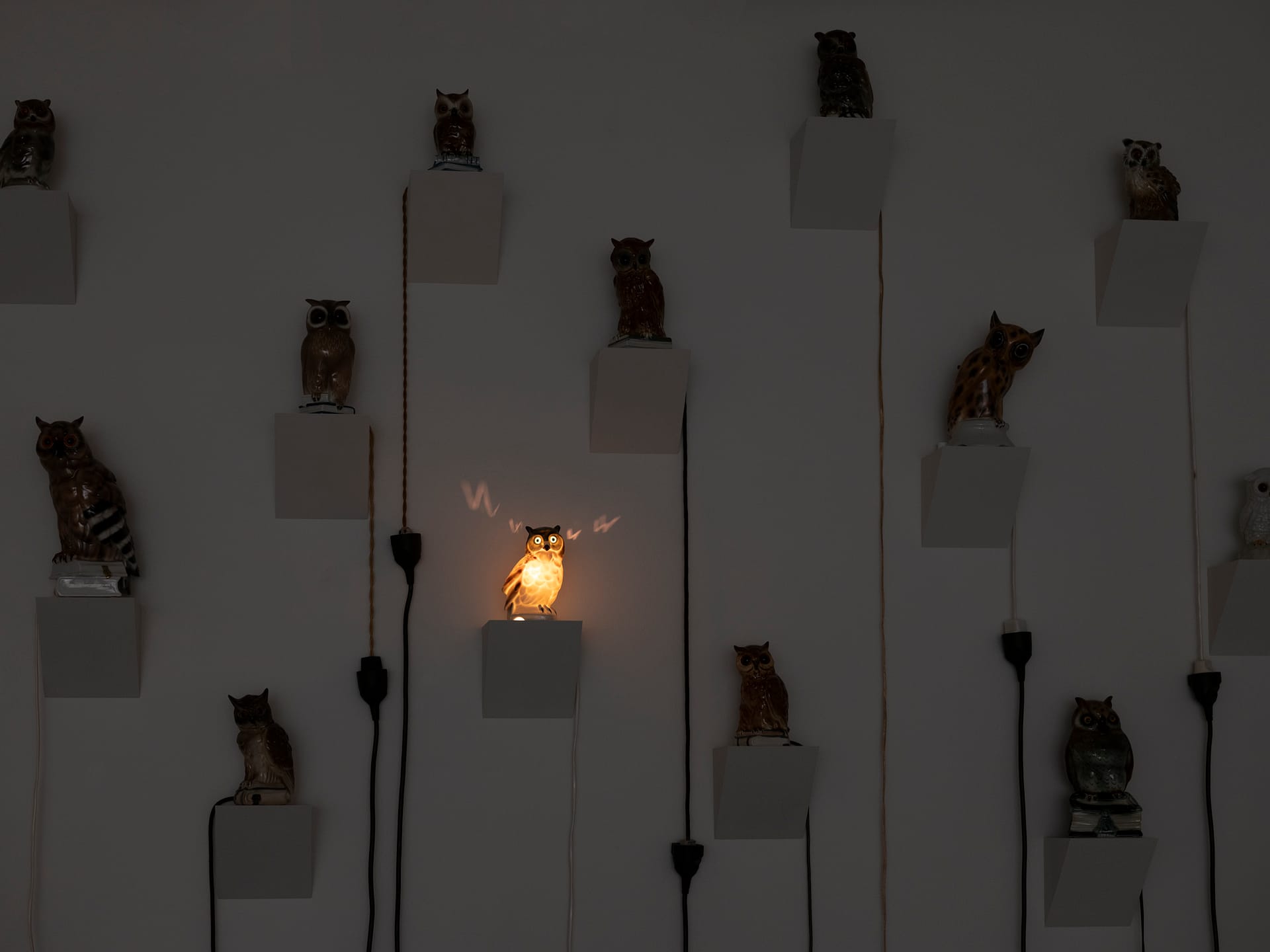
Oscar Eriksson Furunes, night watch, installation view from K-U-K, Trondheim. Photographer: Susann Jamtøy
Notes
1 Giorgio Agamben, ‘The Original Structure of the Work of Art’, in The Man Without Content (transl. Georgia Albert, Redwood City, Cal: Stanford University Press, 1999), p. 99.
2 See Elizabeth Freeman, Time Binds: Queer Temporalities, Queer Histories (Durham, NC: Duke University Press, 2010).
3 Oscar Eriksson Furunes, ‘red light blue night watch’, in Karin Hald (ed.), Malmö Art Academy 2022–2023 (Malmö Art Academy, 2023), pp. 22–37.
4 In conversation with the author, February–May 2025.
Photographer: Matthew Dyczek
Håkon Lillegraven is a curator, art mediator and writer, based in Oslo, Norway. Especially invested in queer, norm-critical, and performance-based practices and artists and stakeholders within these, his curatorial work most often manifests through new performance productions and interdisciplinary public programming. He has held editorial responsibilities and contributed as a writer to Kunstkritikk – Nordic Art Review, C-Print, Billedkunst and Morgenbladet. In 2023 he was a curatorial resident at ISCP – international studio and curatorial programme in New York City, and he is currently employed as Curator of Education and Public Programmes at the National Museum in Oslo, Norway, where he is working towards the exhibition project Deviant Ornaments and a new discursive performance programme.