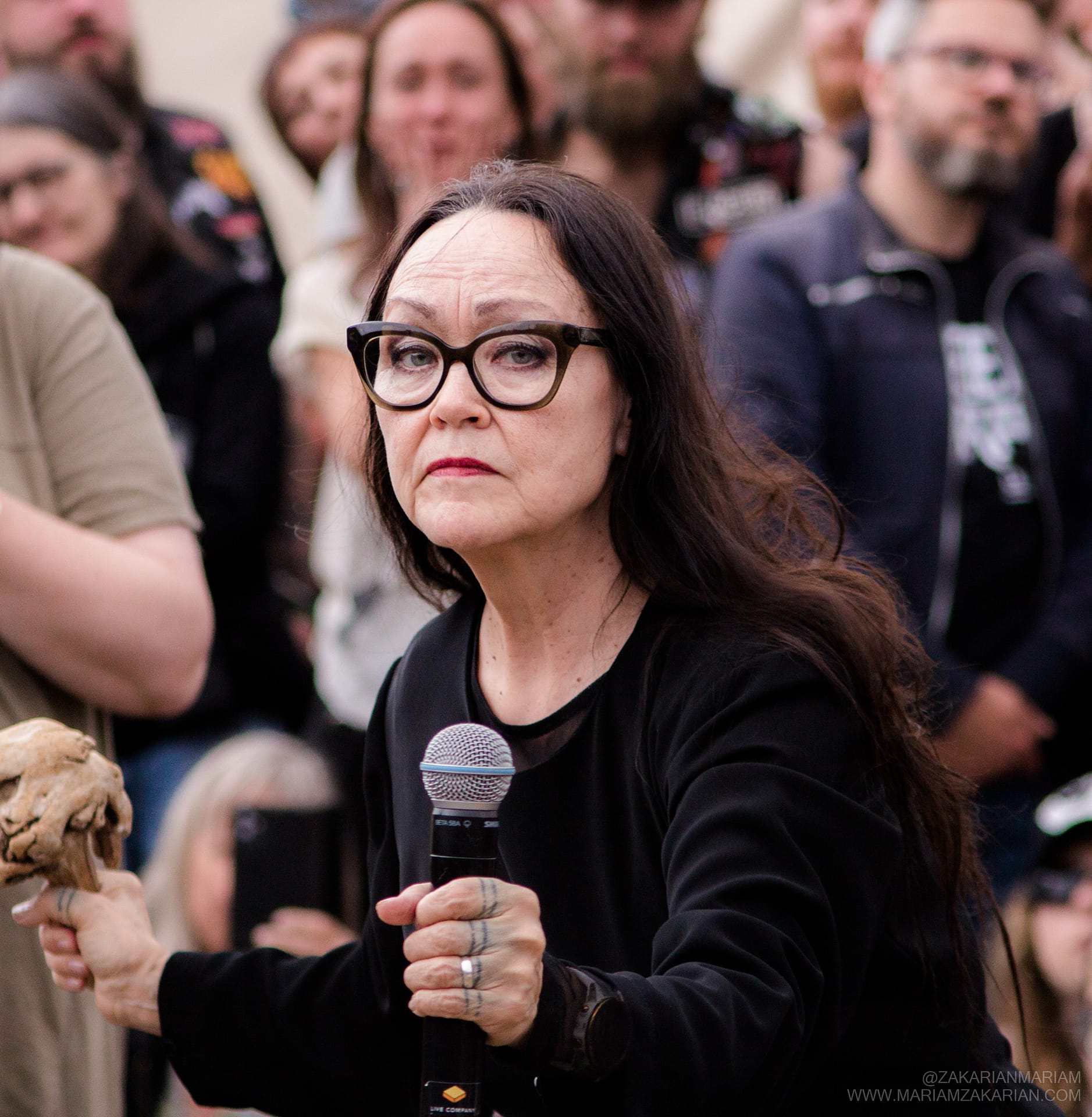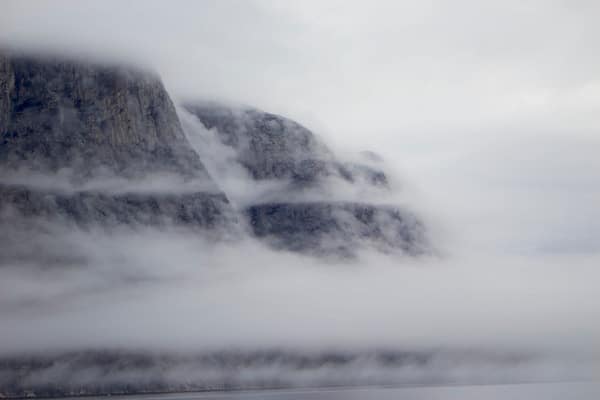
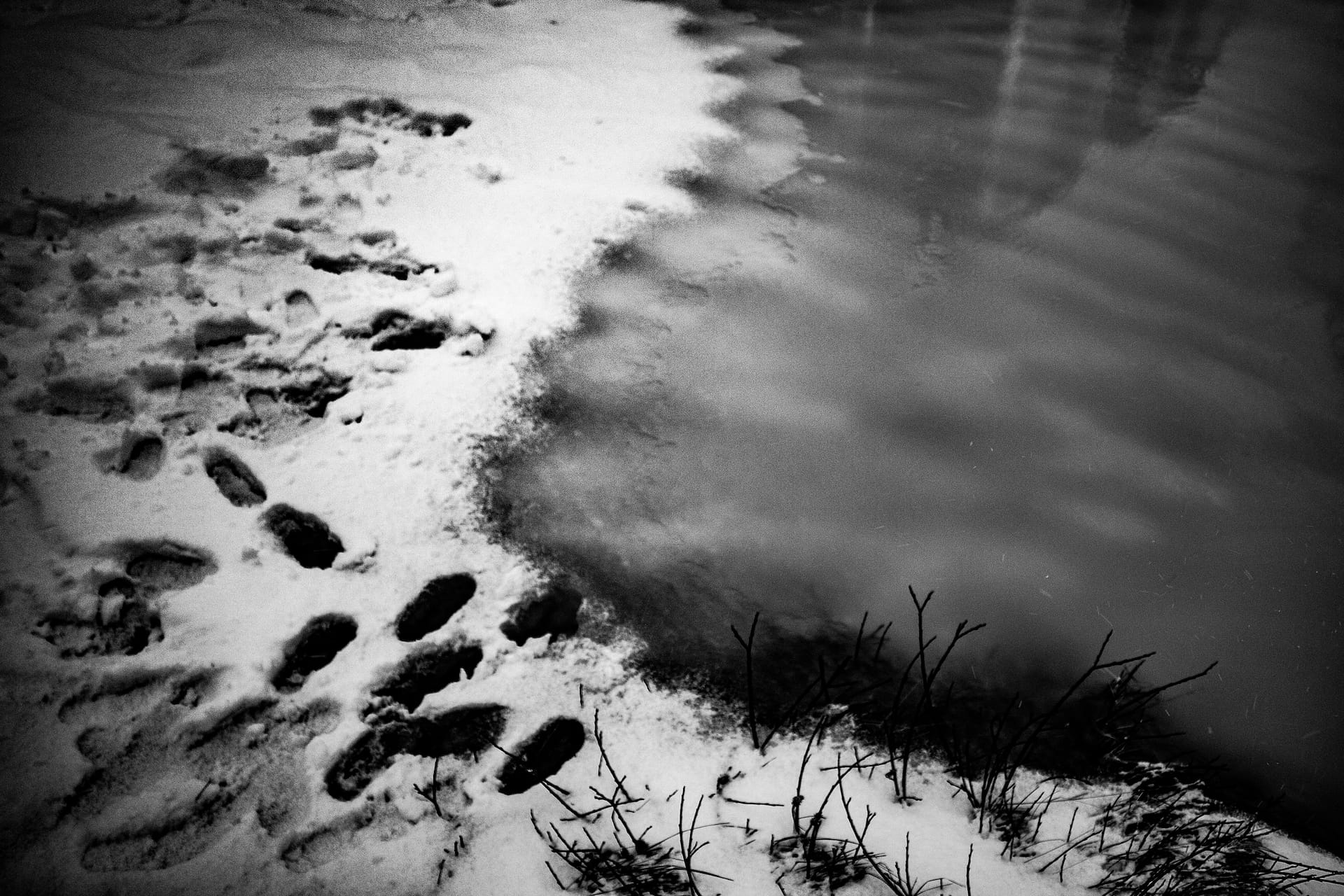
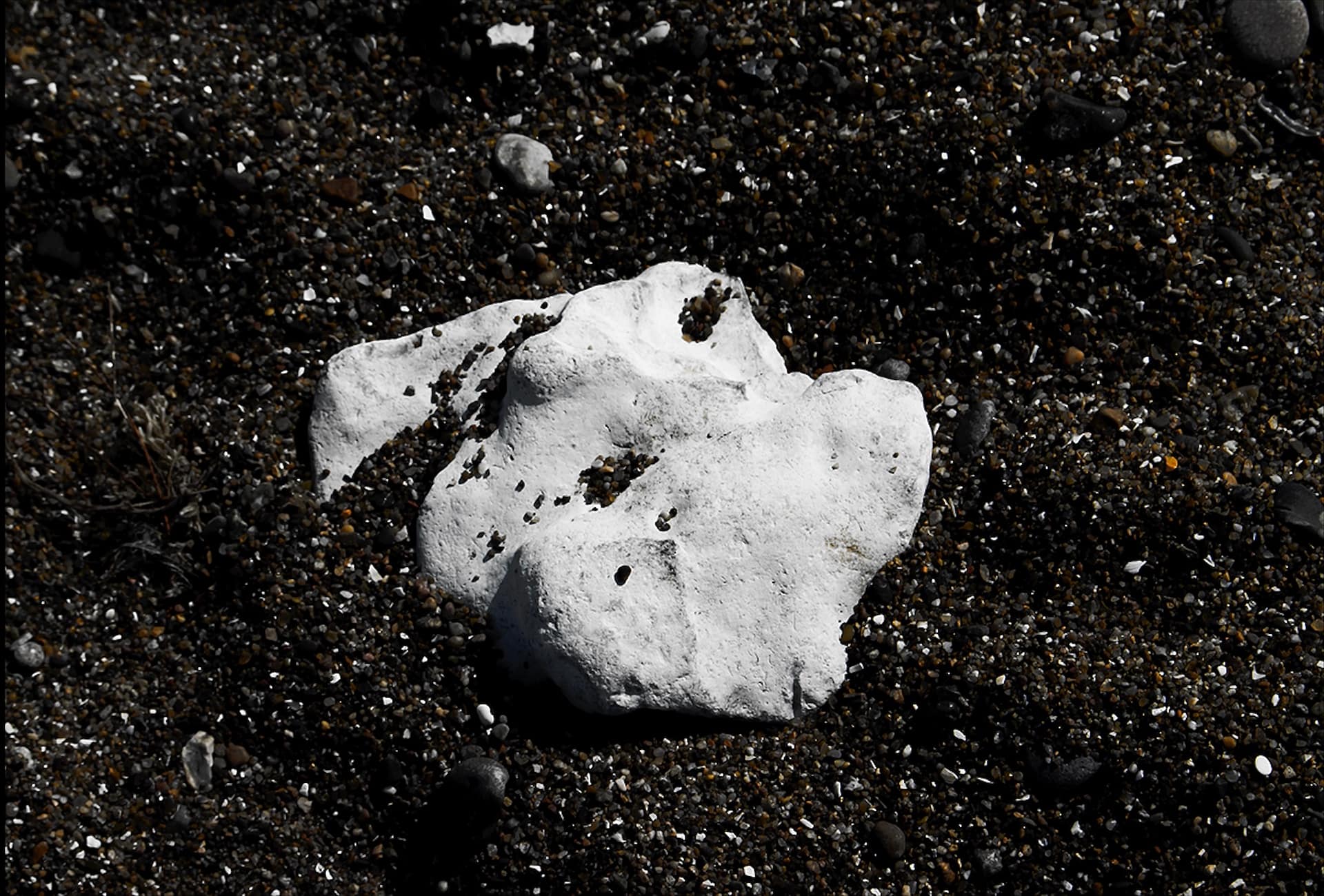
There is a line that appears to be clear and distinct, almost sharp, although the image at first sight looks quite rugged, foggy and uneven, as if the darkness within it is emitting more light through the surface. Is it the reflection of an outside light that makes it shine? Sometimes thoughts of thinking interfere with our perception, with what we think we’re seeing.
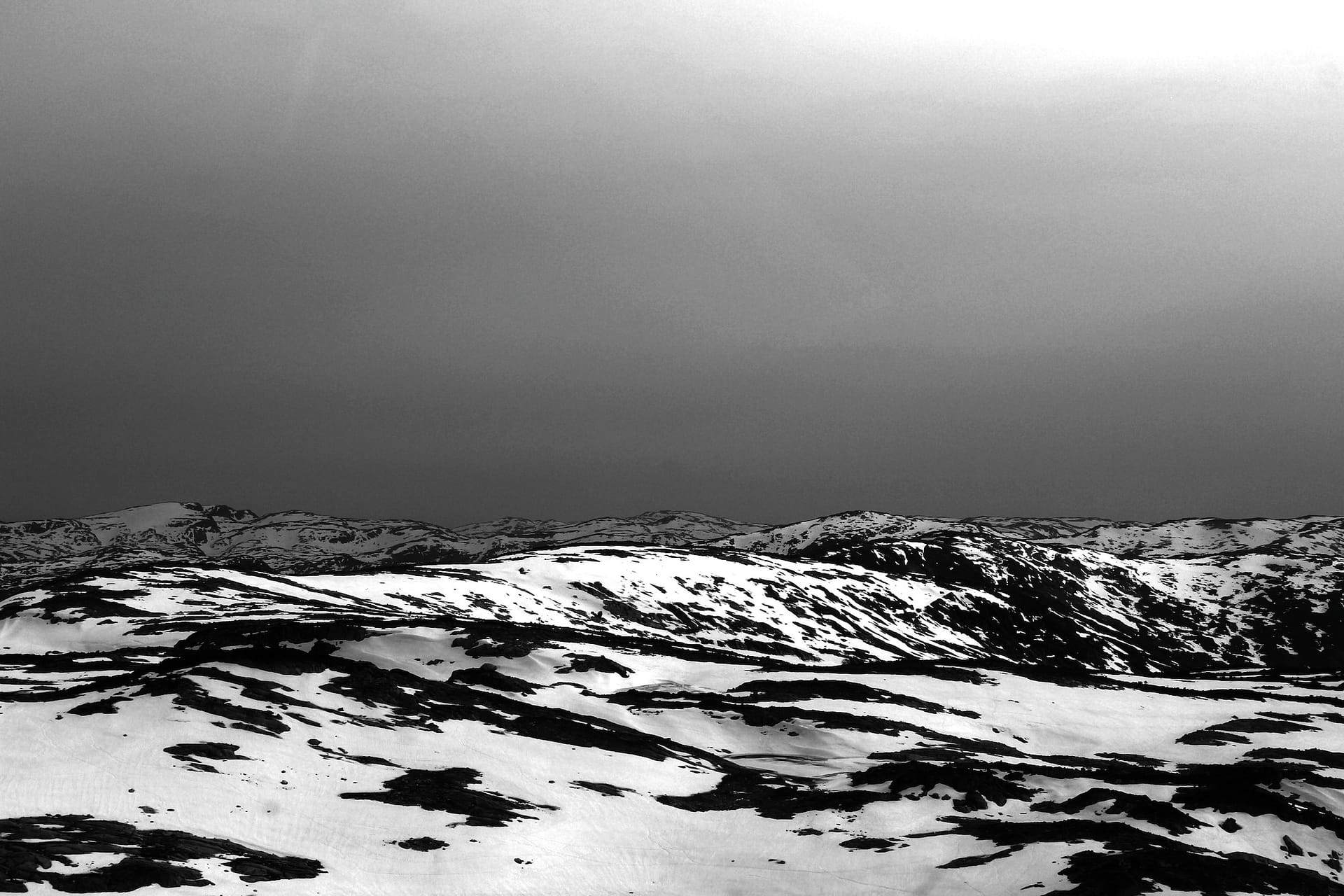
Nina Sikkersoq, Inuit Nunaat (Land of the Humans), 2018, digital photograph
Does it also mean something, IRL as it were, if the visual equals our experience? What is dream, what is reality? These notions, and therefore these values, are under attack from everywhere, also in our times, and we know where these attacks are coming from, I’m just saying, because they have been all over the headlines, on and off, since 2019. The year might just as well have been 1977, 1948, and so on without the headlines as the ones known as Breaking News. This story is, in fact, anything but new! Not for us, who grew up with the chokehold of the colonial era, who already know all the signs, sounds and thoughts, the wrong narratives and positions. Therefore the disorientation.
Yet this reality has older and deeper roots than what we see as not just ‘the images overflowing the whole surface’. It has been the story of every kalaaleq inuk’s life for at least a few hundred years. So I often think: who is the protagonist, who is the poet, who are we, who is the photographer, who are we, and who is the artist, the dancer, the coach, who is the composer, the musician, the singer – each and every one of them in each and every story that is ours? When I think of who we are as a body with an almost identical memory bank connected to our system, I feel an immense power and lightness that carries within us, and yet so seemingly invisible to the rest of the world. In fact so seemingly inherent that art or artistic endeavors such as visual arts, poetry and literature, crafts and sculpture moves as easily like we take our breath in and out.
Photography as a medium of self-knowledge or just the fact that it has the capacity to prolong our way telling a story. Not perfect, not epic, not even grand, but true to who we were and who we are, with all our longings and dreams of self-determination for kids, the future grandkids as we would become future ancestors.
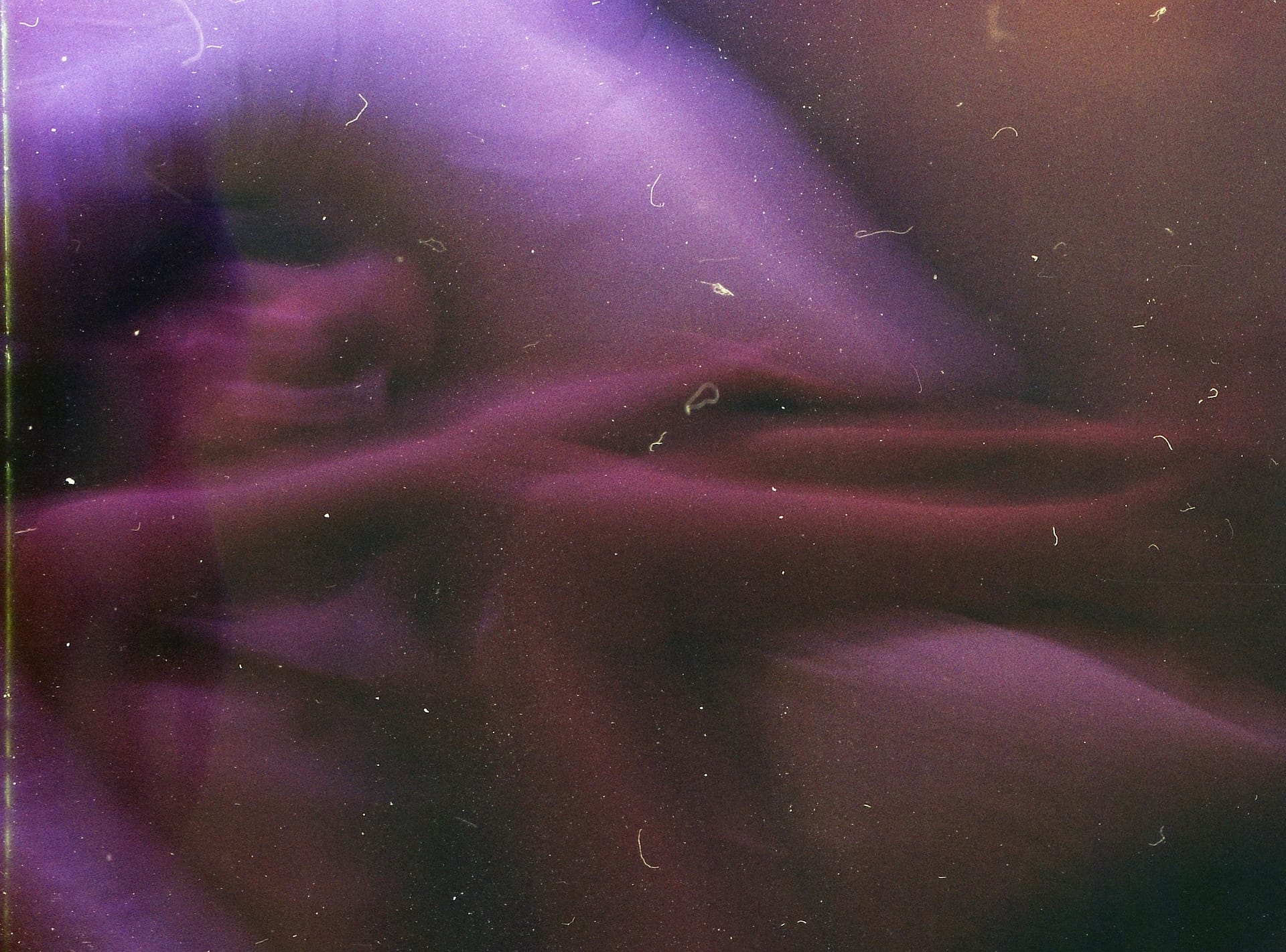
Nina Sikkersoq, Not a Self-Portrait, 2019, digital photograph
Images
I often think of the dancer’s back, how it reflects and acts as a tall column reaching upwards, towards the light, as if with an underlying thought that we, the others, are down there in the darkness, stretching to reach the light. After a night of impossible and dark sleep. We would rather dream ourselves up to the surface, wake up, gasp at the happiness of inhaling clean air, see the sun blinding us over the horizon, listen to the birds outside and throw the window wide open, oh, the world, look at the world, we’re here, what joy to rise to a perfect and great world! Even in the rain and sleet of Nuuk on the third day of Christmas, big warm snowflakes softly melting on the face, never mind it is grey right now, in a moment the dense fog will clear and the snow will slowly become hard again, the cold will hold and it will stay white for a long time still. The world will hold! For now we have to jump over the mushy and icy snow that fills the asphalt roads, in a little while, when the light withdraws under the horizon, we will walk blindly.
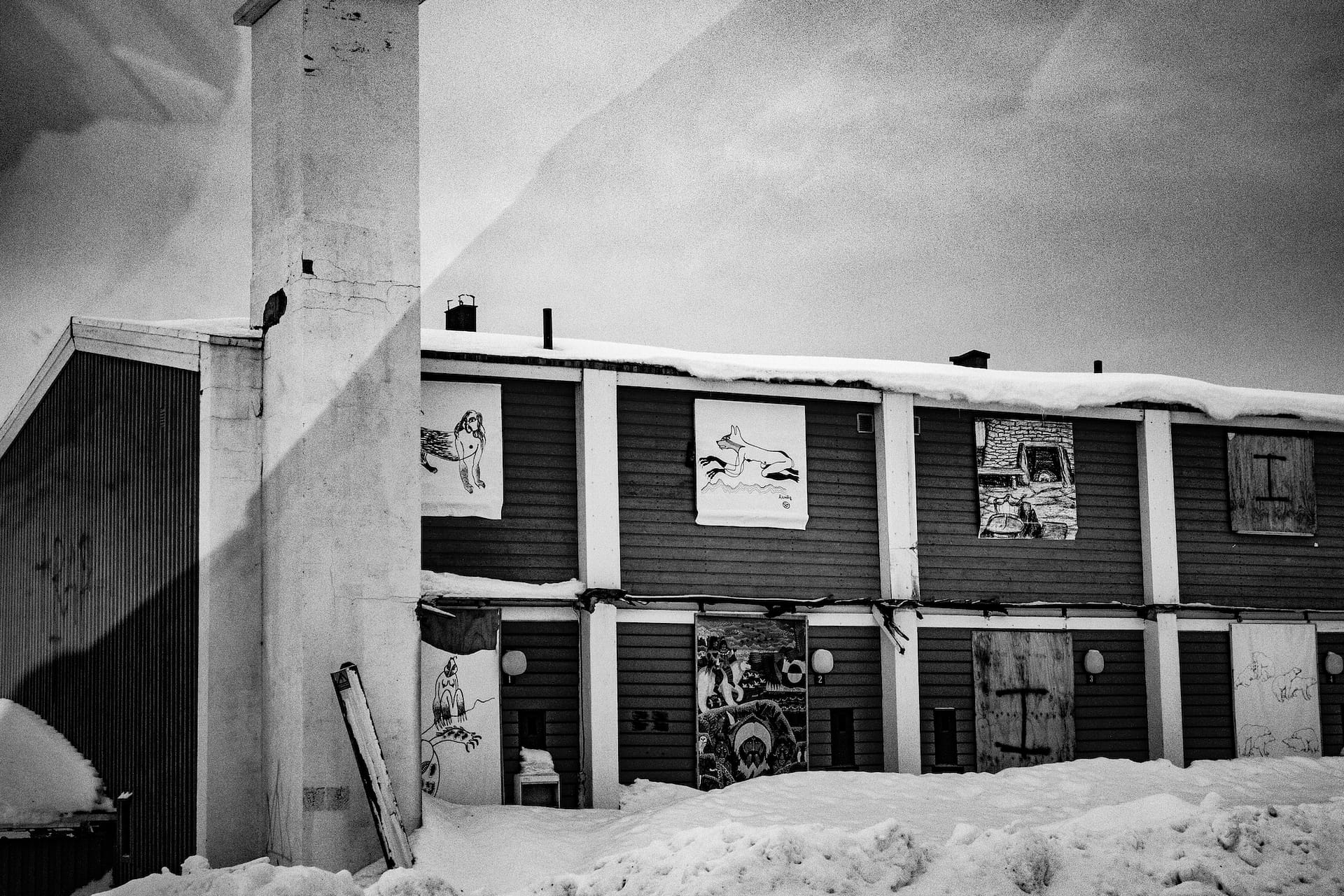
Nina Sikkersoq, Forbidden Culture in Concrete, 2018, digital photograph
We’ll just have to keep our back straight, the entire skeleton will ‘get a workout’ every single day and nothing will stop us. We sense and dance our way through the landscape, through the curving and often steep uphill routes through the city’s roads. We have the mountains, the deep valleys between us, and the highrises stand like towers. The towers of The Hague aren’t higher, I tell you that. And again, we’re just walking here around meltwater lakes, in the city centre or out by Store Malene (Ravnebakken no longer exists, and Nuussuaq, one of the new housing areas of the late eighties, is already a slum) or the surrounding sea, we are a spot on earth in its topmost and most ancient bedrock, which makes up the backbone for the skeleton of the earth.
I’m like that person who lies prostrate inside the tent in summer, and has just woken up one morning that perhaps isn’t a morning, no clock is ringing and I can go and fetch a bucket of water from the river for my coffee, perhaps I’m at Kapisillit kangerluat like my father used to be in his happy summers or soon on my way back from the tour of the Birds’ Rock where we used to collect eggs, I was hoisted up and down and curled my little arms and hands so carefully around the eggs one at the time, don’t drop, don’t shout and definitely don’t wiggle your legs. Listening for a sound from my uncle, who was holding the rope around my waist, the rest of men around, one at the time. The air and the wind, the birds’ cries and the salty sea right in my mouth. Short hair, and a she-should-have-been-a-boy, that’s OK, they wanted to name me after my dead uncle. I’m me, and some moments are totally clear. Arms and legs, eyes and hands, I’m hearing. We’ll be in time all right, we’ll go fishing too, I’m trying to drown out the smells. It’s just life as it is. The summer heather feeds the fire with lively smells that no money can buy.
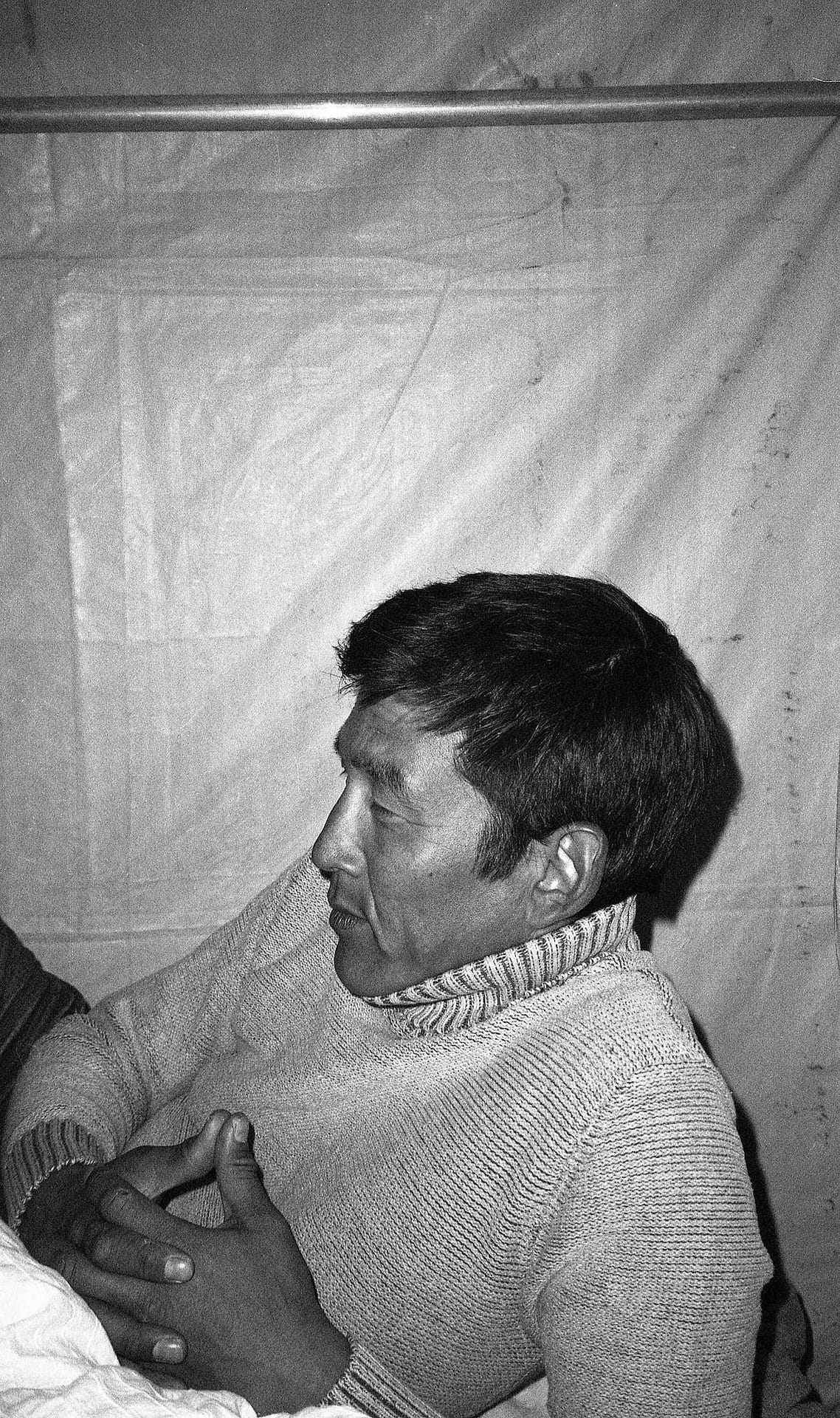
Nina Sikkersoq, Admiration of Silas, 2018, digital photograph
The soul must be beautiful in a world trending towards ever darker and grimmer aspects of human life, in this time that is with us right now, that this very moment appears to have been sidelined.
Inuit time is human time. Nina Sikkersoq’s images show time as subtlety where changes show up unnoticeably. What can be seen when life just goes on and most things are kept under wraps? Of the white that becomes grey that becomes black. Snow may be the time we know and can relate to best, when references about place and time are put forward as arguments against notions about the infallibility of the church and of beauty. In our reading: the ‘calm’‚ and thereafter the ‘storm’ in nature. It’s all images, and our information and remembrance, even our memories, are shaped by images carved into being in this time.
Nina Sikkersoq, Not Vanished – Just Not Physical, 2018, digital photograph
In current news it is portrayed as violence, as alienation of the old in the new present, the insecure new present, and of the golden future that we are being promised.
Somebody is saying: ‘Just forget the whole thing, forget that you came from nothing, that you came from poverty, foul-smelling primitivity. And if you don’t want to forget, shame on you! Because we’re coming to save you, because we’re coming to make you rich, and in exchange for that you shall live in the Reservation of Greenland – there will be nothing in between this time and after, and your memories will be erased!’ Well, honestly I (we) dislike this kind of rhetoric, and writing it is bad, bad, bad. Pretend you didn’t read this. Better erase this, skip it, thank you!
In between all of this we walk as if we were dancing, back and forth and sideways, as long as we’re getting ahead. Because we know: Open-ended Overtime remains. Someone is above us, that we know, it has been like that for 304 years, therein lies the Overtime.
Nina Sikkersoq, Rooted Free Birds, 2018, digital photograph
The simple reason was that we agreed to adopting the only god as one of our own, there was only one and then we adopted ‘him/them’ when the Norwegian-Danish missionary Hans Egede arrived in our country, Kalaallit Inuit Nunarput, and one of our angakkoq’s (shamans) took pity on him, he said: ‘really, you only have one? We have so many and surely we can take in one more.’ And lo and behold, that had consequences. The centre of the world shifted noticeably. History as it has been told is shifting, once again. It was about time, thank God, it was about time they said!
Nowadays we’re digging deeper, we’re in the streets demonstrating and marching against wrongs that are being committed against us, and not least committed against others. We shout, and we sing and we beat our drums for the world. The Spirit world must engage in this battle of humans. In the 1970s we did it, and in the 1980s, and we keep doing it today. Nina Sikkersoq is the many faces, she is their voice, they are dancing this protest and a statement to make the very ‘backbone of the world’ straighten up even more while the continents are moving. This has not only happened before to us Inuit, us who have wandered through centuries and mixed with the world, through ice, hunger and slow death, through alien confrontation and a long peace. The new imperialism and fascism isn’t just happening to Palestine, Afghanistan and Iran. Where is it not happening? Who is next? And don’t call it love, it should be called full act of violence and most of all, it happens in the shadow of the climate crisis, as a coercion and distraction we may say.
Nina Sikkersoq, Nukiga (My Strength), 2017, digital photograph
The sea level is rising exponentially from both poles, while the earth is burning. A human being is not alone, the cycle of history belongs to humans, and therefore theatre is like the wheel of life that starts rolling whenever we have to scrutinize our conscience, our soul. Where are we heading and who are we – and do we remain the others? The next ones? I am asking on behalf of me thank you. Me is you, you is me. (And yes, pardon, excuse my French, I am not going to write it right.)
More images
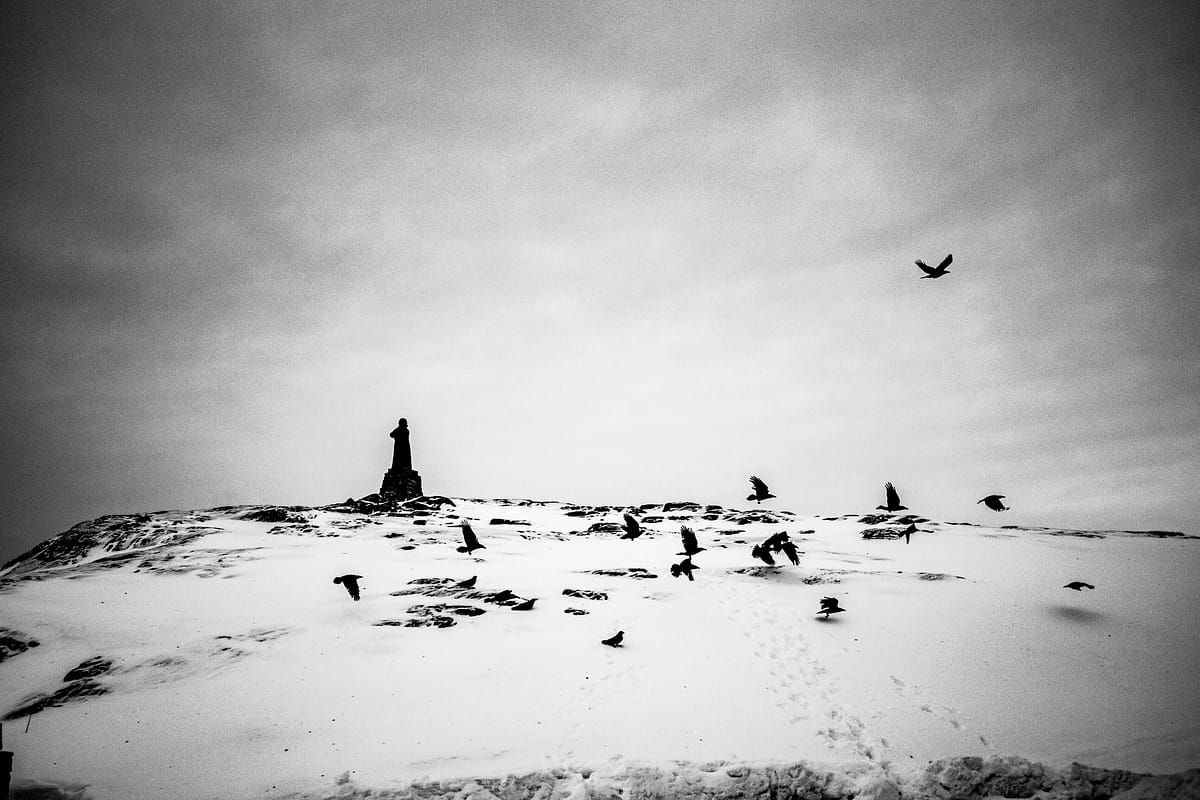
Moreover, he, the stiff statue of the missionary Hans Egede, is not the only one of his kind, he has a double outside the Marble Church in Copenhagen. How weird is that? people in so-called better circles protest when young activists pour red paint over the statue, or scribble borders of inuit kakiortinneri (Inuit tattoos) on its cloak. One wonders why they can’t just let the paint be once in a while, or go all the way and paint the whole thing red – give it a shifting colour, shoot video projections onto it, let it speak, give it music, poetry, rap and dance, film, or in general let the present be present. Let it become art in the name of art? When the city anyway thinks it should still be there. Think of what might happen if we got together in dialogue about the place and took ownership over things. At a long distance it’s hardly even visible. and that speaks volumes about who has the right to define a piece of history like the Church of Greenland. A photograph. Why is it so hard to see with open eyes, and who has decided that we aren’t supposed to?
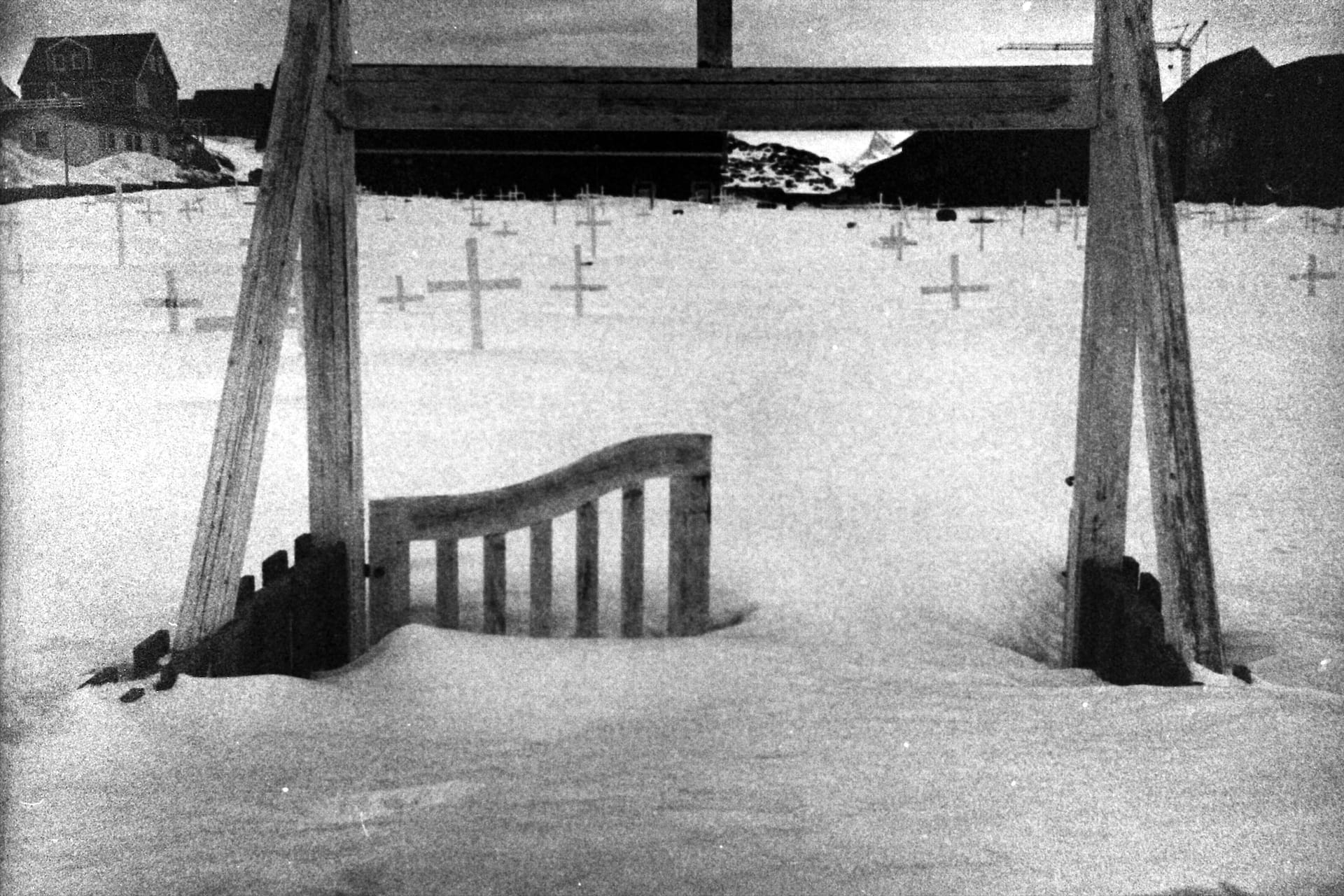
Nina Sikkersoq, Farewell to the Physical World, 2018, digital photograph
21 June is the date for the longest day of the year in the Northern Hemisphere, and that day is also Kalaallit Inuiattut Nalliuttorsiunnerat, Greenland’s National Day. A few years ago a newly appointed priest in Nuuk was fired because he had invited a West Greenlandic drum dancer (until then drum dancing in West Greenland had been pronounced dead for more than 300 years) to help him celebrate mass that day, when the sermon and hymn singing were broadcast directly on KNR, the national channel. So much for all the fuss of returning what was once ours, the word the song and the dance. A revival of worship was denounced as an ungodly act, oh the many small gods, come on, there is room for many!
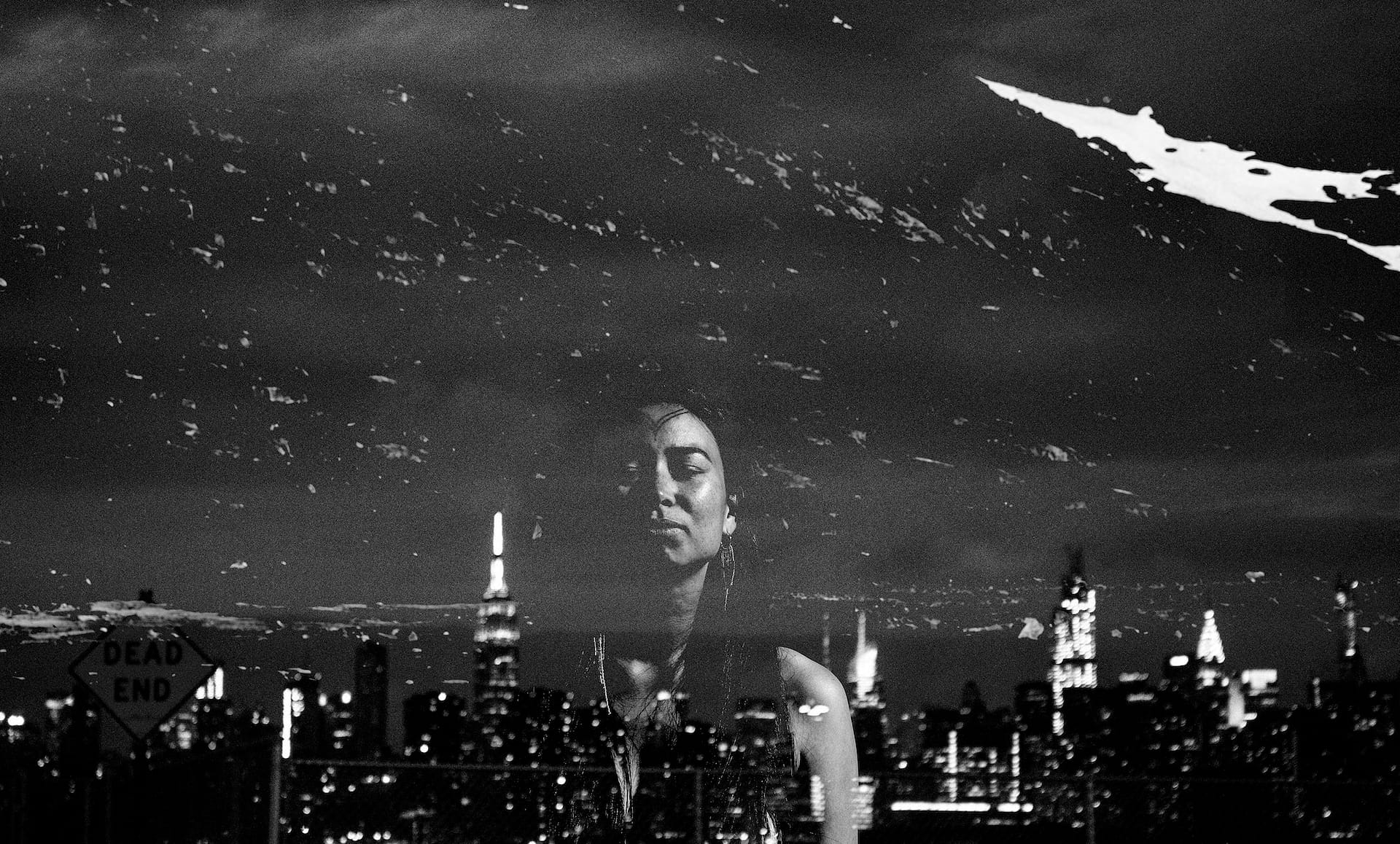
Nina Sikkersoq, In-Between, 2022, digital photograph
When I see Nina Sikkersoq’s self-portrait, with the image of the person above the NYC skyline, I think of power. Who has the power over the image of us? A self-portrait is about claiming this power, and it may retell history from many different angles, not least from its own position. In addition, the portrait of the photographer as artist is a statement about ownership, about the image and the story of the image. The artist who has conquered the world and not the other way round, an ironic gesture (and a fuck you!) that I hope all who see it will understand. The world is now, in all its raw brutality and beauty.