In the work of art, the meaning of the subject becomes a spatial appearance, while in photography it is the spatial appearance of a subject that is its meaning.1
– Siegfried Kracauer, Photography (1927)
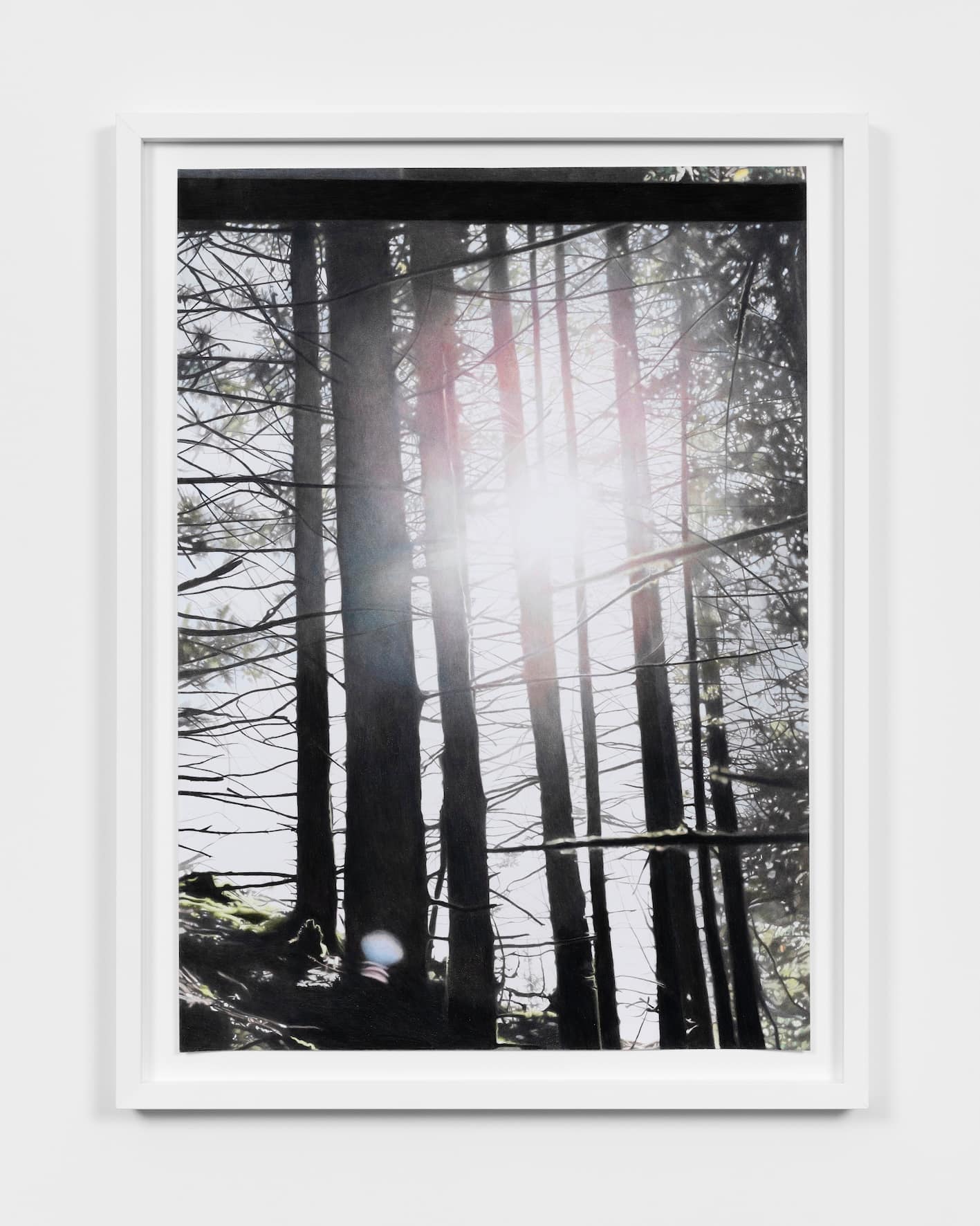
Hanne Grieg Hermansen, Fra Dale (From Dale), 2023, colour pencil on paper, 70 × 50 cm. Collection of REV Ocean, Oslo. Photo: Istvan Virag
1.
The photograph’s claim to realism rests on its indexicality, meaning its causal, mechanical link to the world by way of light refracted through a lens, imprinting an image on a photosensitive surface. Drawing is an equally indexical medium, although what it traces is not the outer world but rather the hand’s slow passage across a surface: the pressure of the pencil and the conscious buildup of lines into figures. Unlike photography, which could be characterised as a depersonalised medium, the process of drawing requires hand-eye coordination and sustained, conscious attention.
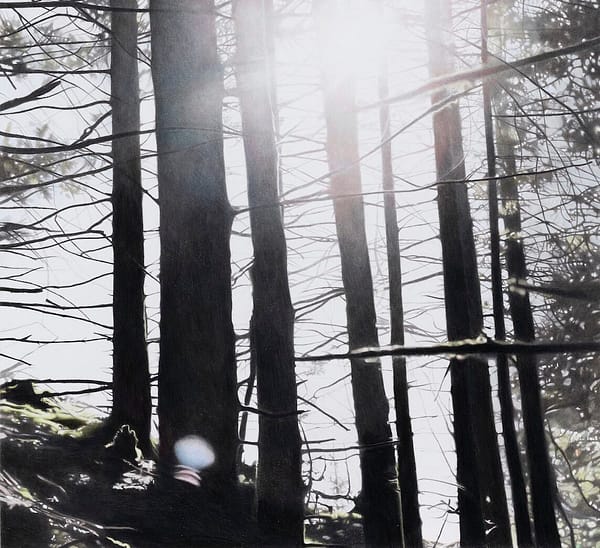
The tension between the near-instant, mechanical process of photography, and the slow process of drawing has been at the core of Norwegian-Sami artist Hanne Grieg Hermansen for more than a decade. Hermansen meticulously reproduces photographs of nature or pure light through entirely hand-drawn methods, usually graphite and coloured pencil. There is a strict elegance to her hyper-realistic recreations of sparse and often stark natural landscapes, with particular emphasis on light and the variations it produces in intensity, contour and shadow. Sunlight might peek through the trees, such as in Fra Dale (2023), or a flash might illuminate leaves and tangled stems against pitch-black darkness in Blitz (2010). In both cases, what registers is the capacity to mediate. We tend to look through photographs as if they were transparent, treating them as slices of the world rather than objects in their own right. Hermansen’s drawings reverse that habit.
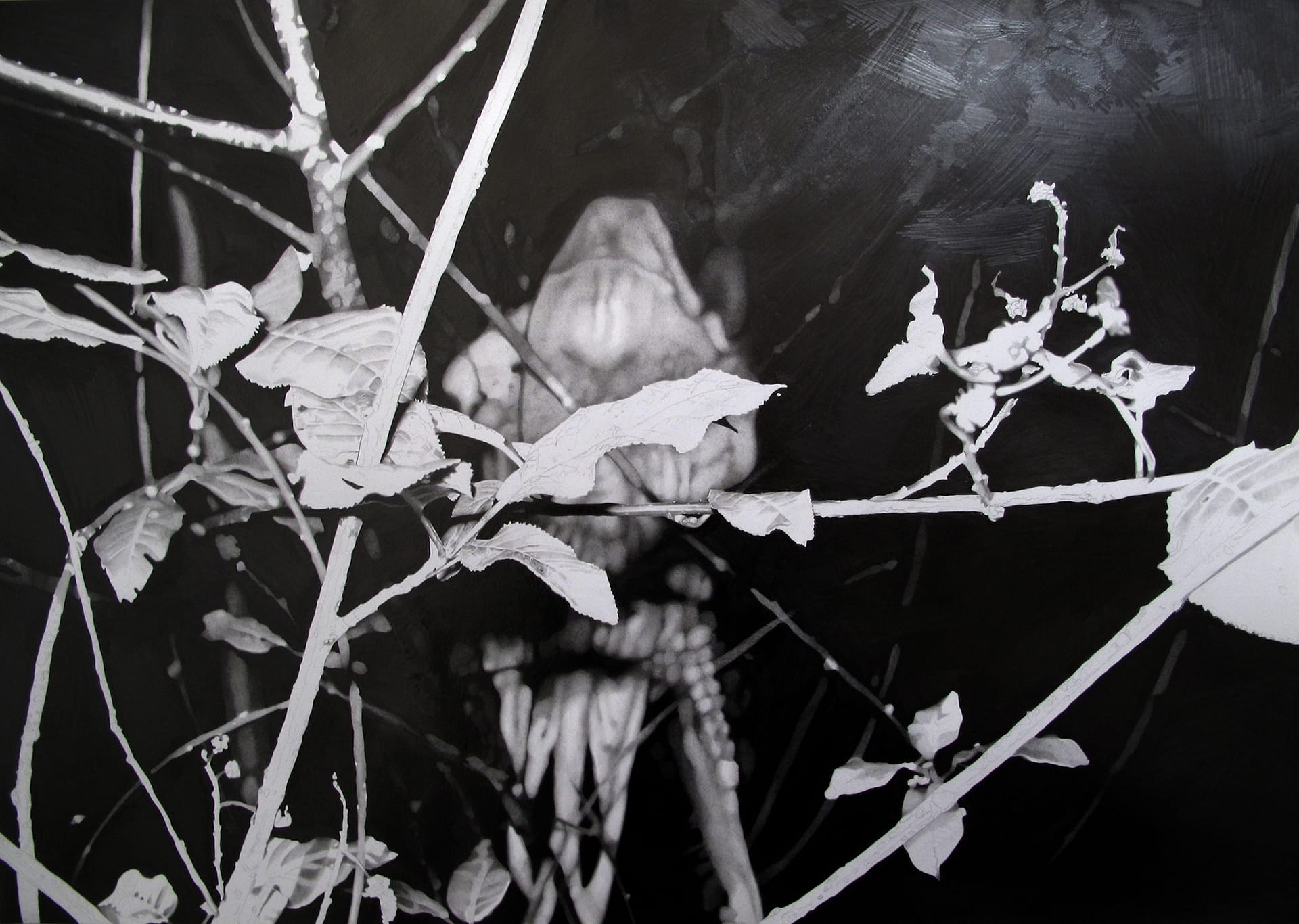
Hanne Grieg Hermansen, Blitz, 2010, pencil on paper, 50 × 70 cm. Photo: Hanne Grieg Hermansen
The photographs that Hermansen selects for her drawings are notable for what they omit: buildings, people, vehicles and signs of human habitation and culture are almost always absent, although in rare instances the photographer can be glimpsed in a reflection or as a shadow. Significant emphasis is frequently placed on the signifiers of the photographic process itself, including chromatic aberrations, lens distortions, the aforementioned flattening effect of flash use, and the marks left by film stock such as grain, colouration or light banding. Scratches, hairs, and other imperfections resulting from the photographic development process are rendered with stringent, near mechanical precision.
The result is work that seems to exist outside of any fixed sense of time, anchored neither to the moment of the photograph’s making nor to the hours of careful attention required for its hand-drawn recreation, but suspended somewhere between the two. Memory is selective – we tend to only remember those details that carry meaning in a particular moment – while the photograph records indiscriminately. Hermansen’s drawings embrace the stickiness of the photograph, reproducing its material qualities with the same exacting detail as the light which struck the photosensitive surface. What is frequently foregrounded in Hermansen’s work is not the world, but the camera membrane between the body and world, made visible by paying attention to the indexical traces it leaves behind.
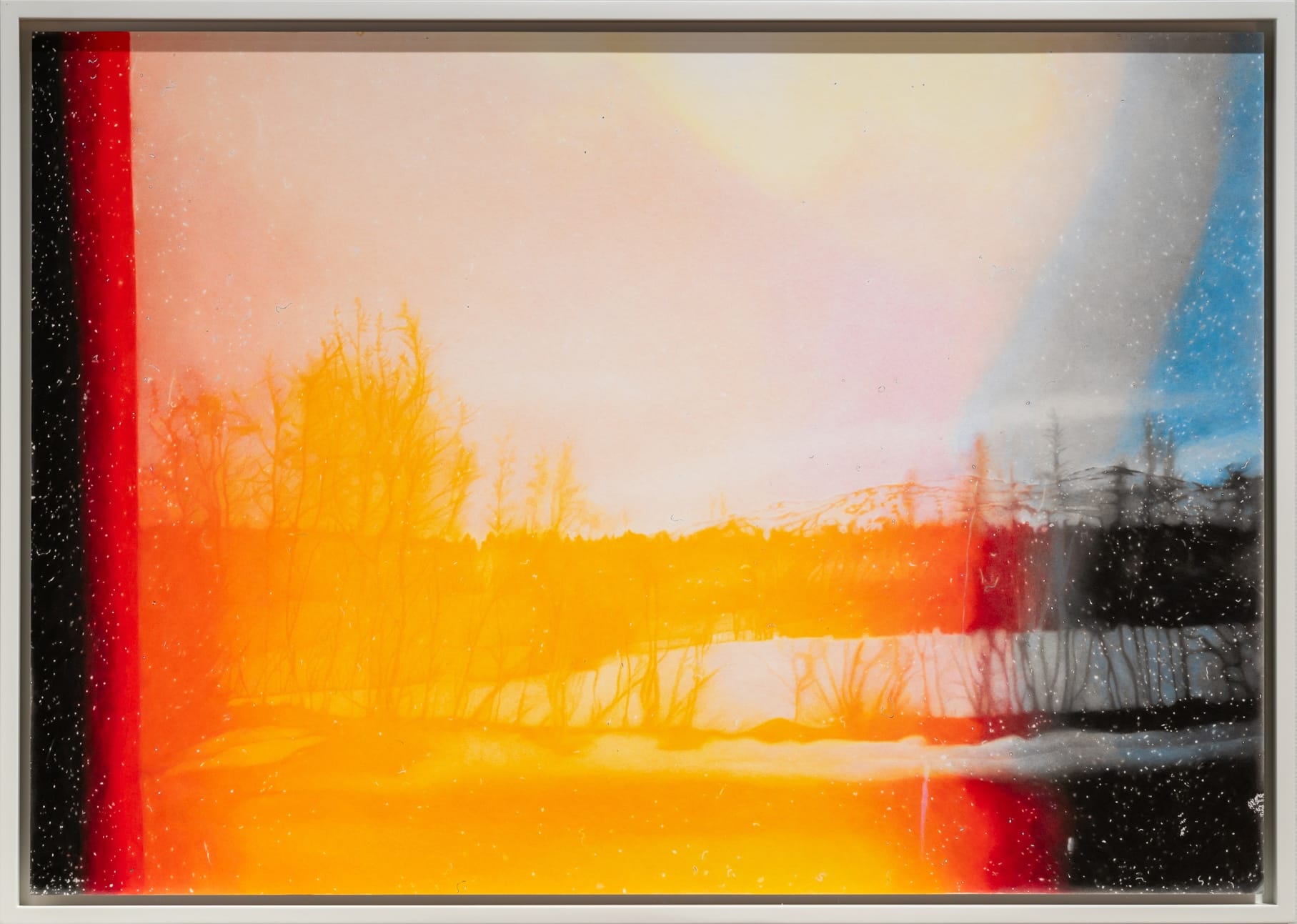
Hanne Grieg Hermansen, Ruovttaluotta, 2024, colour pencil on paper mounted on aluminium, 70 × 100 cm. Photo: Kjell Ove Storvik
2.
A photo of a snow-covered landscape with bare, leafless trees in the foreground and a low treeline receding toward distant mountains is the subject of Hermansen’s colour drawing Ruovttoluotta (2024). Most of the image is saturated with an intense orange-yellow wash – likely the product of severe light leakage when the original photograph was taken – increasing in intensity from left to right. The layer of bright colour flattens the image, and gives the trees a ghostly quality, as if the entire forest is one dark mass. White specks and marks across the darker sections of the image suggest that the photographic print must have been affected by dust and handling over time.
Despite its opaqueness, Ruovttoluotta is nonetheless among Hermansen’s most explicitly personal works: the photograph on which it is based was taken in Kautokeino, a municipality in the far north of Norway and one of the most significant centres of Sami culture and language in Sápmi, the Sami homeland spanning Norway, Sweden, Finland, and Russia. Grieg Hermansen lived there from the age of three to six – her father had moved the family to Kautokeino to help establish Beaivváš Sámi Našunálateáhter, the national Sami theatre – before relocating to Oslo. The photograph was taken by her upon returning to her childhood home at the age of twelve, and its title – meaning ‘the way back’ in Northern Sami – reaches toward that memory as well as issues of ownership, repatriation and national identity. The Sami are an indigenous people recognised as a national minority in Norway, but who for much of the twentieth century were subjected to policies of forced assimilation – known as fornorskning – that systematically suppressed their language, culture and land rights. For many Sami people, holding onto their identity involves navigating a relationship to a past defined by erasure, distortion and loss. Perhaps that process is not that different from the photograph on which this work is based: its exact significance obscured, and yet irreducibly marked by what was there.
In his book Camera Lucida (1980), Roland Barthes famously writes about photography’s capacity to move us. He devotes much of the book to describing his encounter with a photograph of his mother as a young girl, but decides to forgo reproducing the image, knowing that its emotional charge is entirely subjective.2 For Barthes, the detail that wounds – that which he calls the punctum – is by definition subjective, contingent, and non-transferable. In the case of his mother’s photograph, it is also inseparable from memory. For the rest of us, the same photograph would likely only offer surface or historical curiosity. The cultural critic Siegfried Kracauer makes a similar claim: ‘Beneath a human being’s photograph, its history is buried like under a blanket of snow.’3 The why of Ruovttoluotta, its exact significance, the weight of the image, is hinted at by its deliberate, attentive and hand-drawn reproduction, but cannot be directly read from the image.
In Ruovttoluotta, the traces of the photochemical process – the light leakage, the dust, the colour banding – are reproduced by hand with the same fidelity as the landscape itself. Drawing, historically the medium of subjective presence, of the artist’s hand and eye working in concert, is here enlisted to reproduce the accidents of a mechanical process. The result is an image suspended between intention and indifference. Whatever content is implied – biographical, cultural, linguistic – does not transmit cleanly. We are left on the surface, barred from the exact, personal significance of this landscape: unable to know whether it is rendered as it appears in memory, or whether the image was always this hazy, this impenetrable.
Foregrounding the materiality of the photograph is a reminder that this is an image, a rendition. Whether it feels faithful ultimately depends on memory. The photograph is a trace. The real landscape lies elsewhere.
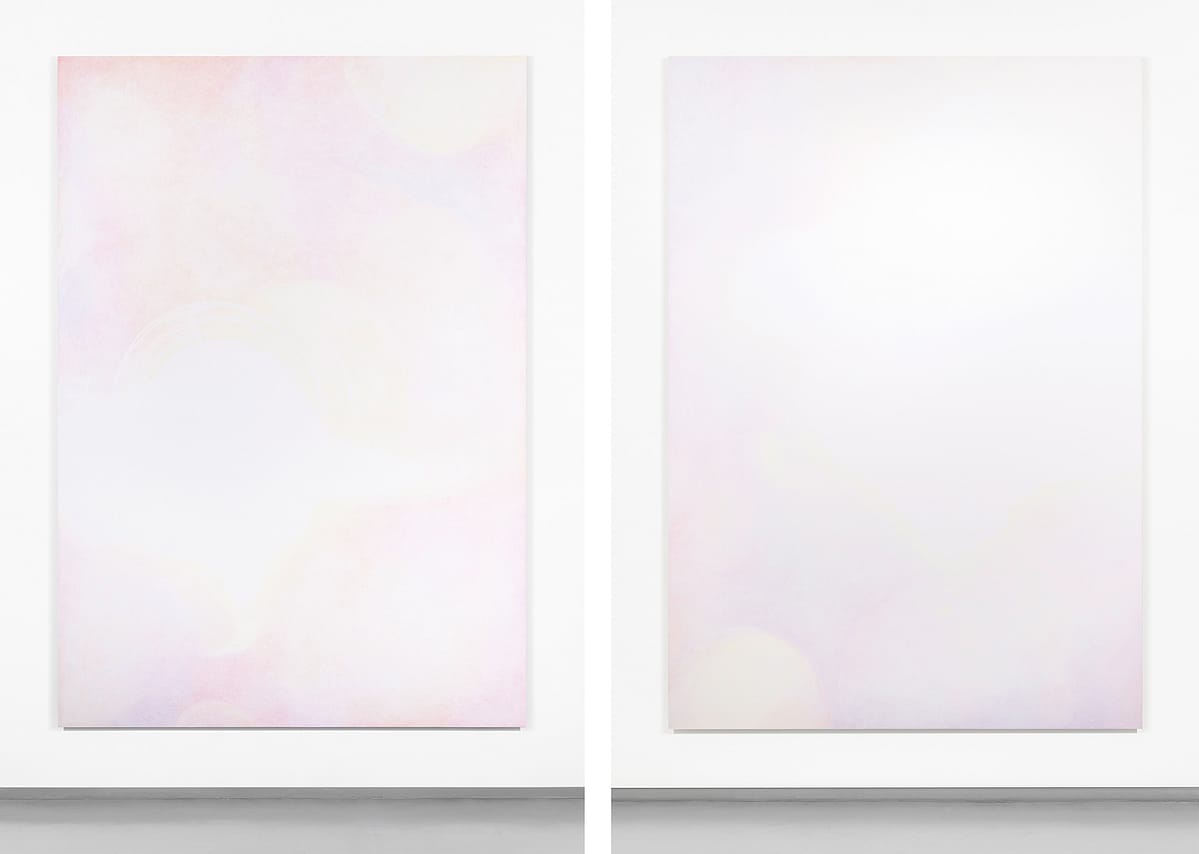
Hanne Grieg Hermansen, Source Four #2–3, 2019, colour pencil on paper mounted on aluminium, 200 × 140 cm. Photo: Istvan Virag
3.
In recent works, Hermansen has tended towards effacing the image entirely, leaving only traces of light. Source Four #1–3 (2019), is a series of three large colour pencil drawings, which were included in her show Dazzlers at Kohta, made from photographs of artificial theatrical light. In order to create them, Hermansen rented a black box and borrowed stage lamps from Oslo’s National Theatre. Photographed directly, the light overwhelms the lens, producing images so overexposed that virtually nothing remains. From these photographs Hermansen created drawings, working with pencil and eraser to achieve tones pale enough to convey what she describes as ‘a development inside the eye’.4
Other examples of Hermansen’s shift towards depicting nothing but light include PAR-16 #1–5 (2020), a series of small colour drawings. Devoid of subject or horizon, each work presents an almost featureless field of pale colour – cool blue-white in the first two works, shifting to a soft rose in the third that fades gradually. These drawings, made from photographs of a smaller theatrical spotlight, are wholly devoid of subject, symbol or allegory. Everything has been subtracted – there is only light.
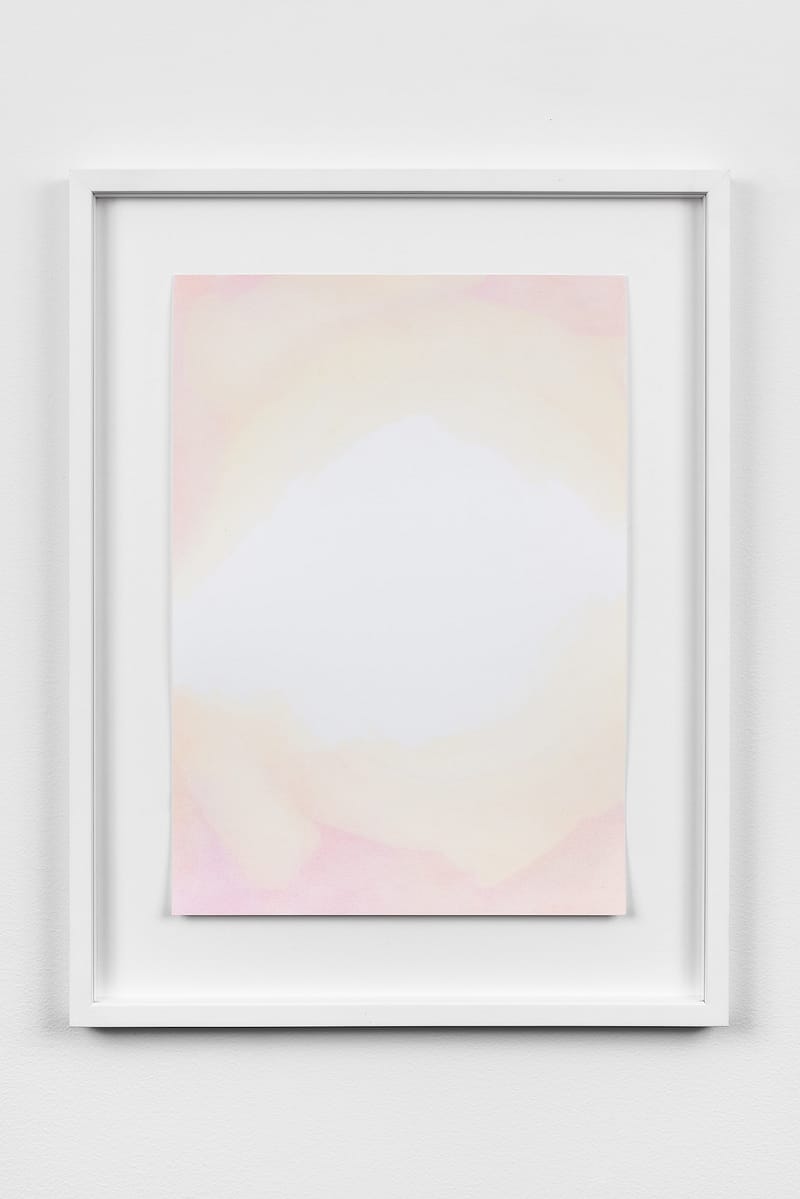
Hanne Grieg Hermansen, PAR-16 #5, 2020–23, colour pencil on paper 42 × 29.7 cm. Photo: Istvan Virag
What should one make of light as subject matter and depiction? A rough and preliminary breakdown of the epistemic phases of light in Western European art might begin with the medieval period, where light signifies divine presence and the promise of redemption. With the Renaissance, light becomes representational, giving depth to bodies and space to rooms, thereby anchoring the world to consistent, observable laws. The Enlightenment extends this logic, making light a metaphor for reason and scientific progress. The Romantic period recovers some of light’s metaphysical charge, but with the key distinction of locating its capacity to overwhelm human faculties and inspire awe in nature itself rather than in God. With modernity and the invention of photography, this changes fundamentally. Light is no longer the content of art, depicted by a human hand, but acts directly on a surface, inscribing its own image through chemistry. It becomes both subject and medium simultaneously.
Writing in the 1920s, Kracauer observes that unlike photography, which coldly registers the world as it is, painting or drawing has almost always tended to reach towards a cultural or symbolic meaning. For Kracauer, this observation builds on Goethe’s remarks on a landscape painting by Rubens, where he notes that Rubens’s use of two light sources emanating from opposite directions across a landscape is contrary to nature, but that this departure is what allows art to reach ‘a higher purpose’.5 Art, in this conception, moves beyond surface, toward truths that are not wholly legible in the natural world. The claim that photography tends towards the non-symbolic, contrary to painting, is later echoed by the art historian Rosalind Krauss, who remarks that photographs ‘[…] seem to short-circuit or disallow those processes of schematization or symbolic intervention that operate within the graphic representations of most paintings’.6 For Krauss, the prevalence of indexicality (and photography in particular) in conceptual art from Duchamp onward marks a broader scepticism toward claims that art can deliver meaning beyond what is physically inscribed on its surface.
From this point of view, the photorealism that Hermansen subscribes to is able to eviscerate any sense of style and historicity beyond what the traces of photographic process might tell us about when an image might have emerged against the timeline of photography as a medium. There is no visible hand, no evidence of choices made within a stylistic tradition. Hermansen’s depictions of light are something like pure presence, outside of any legible markers of time beyond the traces of her two media, photography and drawing. Drawing is slow and deliberate where photography is instantaneous, and yet in Hermansen’s practice that deliberateness produces no symbolic surplus as one might expect, given light’s rich history as carrier of symbolic meaning. Her images of light are about as close as one can imagine to a ‘pure’ image, or an image of all possible images, in the same way white light contains all colours. What both indexes – drawing and photography – ultimately trace is the same thing: contact with a surface, and nothing beyond it. The hand and the lens arrive there together, and neither can go further.
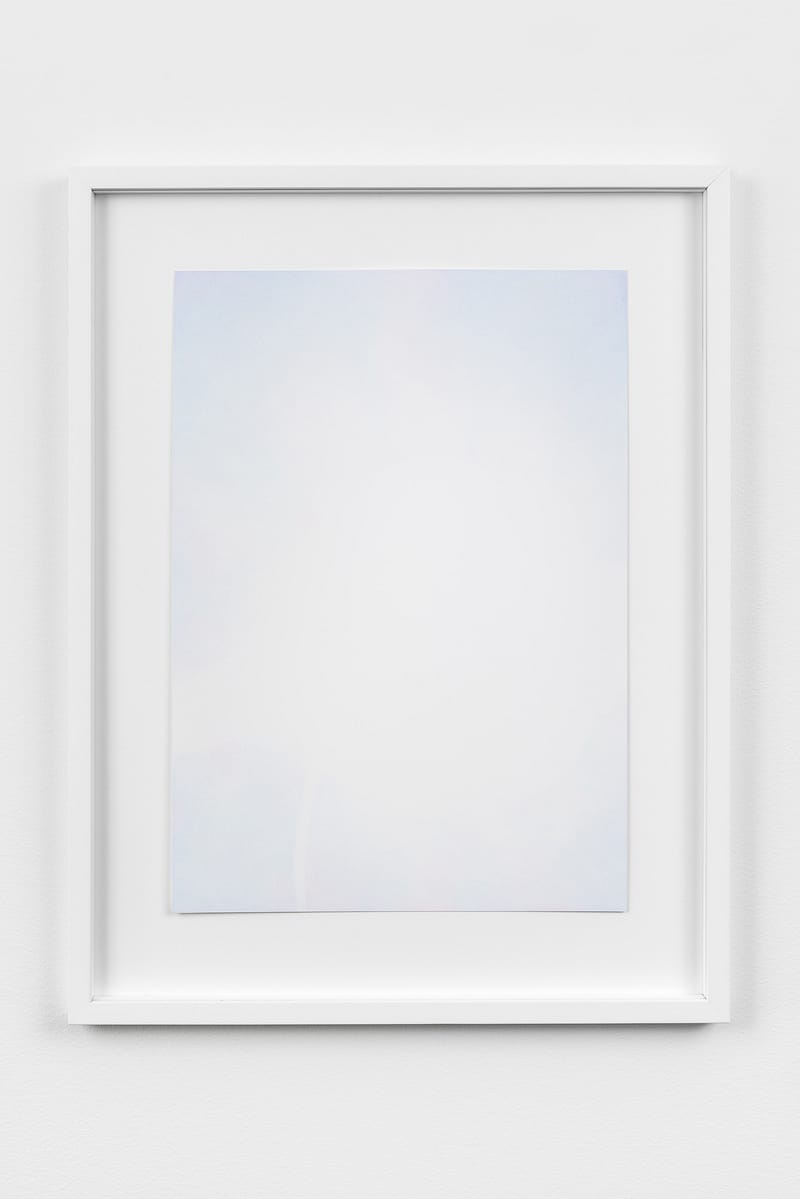
Hanne Grieg Hermansen, PAR-16 #2, 2020–23, colour pencil on paper 42 × 29.7 cm. Photo: Istvan Virag
Notes
1 Siegfried Kracauer, ‘Photography’, in The Past’s Threshold: Essays on Photography, ed. Philippe Despoix and Maria Zinfert, trans. Conor Joyce (Zurich and Berlin: diaphanes, 2014), p. 33.
2 Roland Barthes, Camera Lucida: Reflections on Photography, trans. Richard Howard (New York: Hill and Wang, 1981), 63-77.
3 Siegfried Kracauer, op. cit., p. 32.
4 See the press release for Hermansen’s exhibition Dazzlers at Kohta https://kohta.fi/exhibition/hanne-grieg-hermansen-dazzlers/
5 Siegfried Kracauer, op. cit., p. 32.
6 Rosalind Krauss, ‘Notes on the Index: Seventies Art in America’, in October, vol. 3 (Spring 1977), p. 203.

Nicholas Norton is an art critic and editor based in Oslo. He is the editor-in-chief of the journal Billedkunst and has written criticism for the newspaper Klassekampen as well as publications such as Kunstkritikk, Artforum and Frieze. He holds a master’s degree in art history from the University of Oslo and chairs the working committee of the art section of the Norwegian Critics’ Association (Kritikerlaget). He is also the head of AICA Norway.